
Kokhanovska's excommunication: What the Odesa decree left unsaid
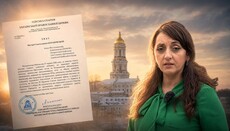
A conflict has arisen in the UOC over a decree issued by the Metropolitan of Odesa barring human rights activist Viktoria Kokhanovska from Holy Communion.
On the evening of Saturday, June 27, a scandal erupted in the UOC media space after the Odesa Eparchy published a decree by Metropolitan Agafangel barring human rights activist Viktoria Kokhanovska from receiving Holy Communion.
Metropolitan Agafangel stated that the decree was prompted by her alleged "rudeness, loss of feminine dignity, deliberate disrespect for the Church hierarchy, the spreading of false rumors and groundless accusations, slander, derogatory remarks, blasphemy, and insults directed at the bishops, priests, deacons, and monastics of the UOC," as well as "deliberate attempts to sow discord between the hierarchy and the faithful" and "provocative calls to undermine church order."
Kokhanovska is a very prominent figure in Ukrainian Orthodoxy. She has represented dozens of UOC parishes in court and saved many of them from seizure. Viktoriia also played an active role in defending the Kyiv Caves Lavra during what she and her supporters describe as the state's takeover of the monastery in 2023. As a result, the authorities opened several criminal cases against the human rights activist, and during the defense of the Lavra she was even allegedly abducted by officers of the Security Service of Ukraine (SBU). Thus, the excommunication of Kokhanovska from Holy Communion should have had very compelling reasons. What were they?
What happened?
One of the spokespersons of the Odesa Eparchy, Archdeacon Andrei Palchuk released a video in which he described the background of the conflict. Following the celebration of His Beatitude's name day, V. Kokhanovska published a Facebook post accusing Metropolitan Agafangel of showing disrespect by not coming to Kyiv in person. In response, the eparchy's press office stated that the Church has no practice requiring ruling hierarchs to attend such celebrations in person, noting that one of Metropolitan Agafangel's auxiliary bishops had traveled to the capital on his behalf. Kokhanovska herself was invited by the Odesa clergy to come to Odesa "to swim, to calm her nerves, and attend an exorcism service."
On the evening of the same day, Kohanovska released a video claiming that Metropolitan Agafangel does not bless his faithful to support the Kyiv Metropolis in the courts, stated that "heresy, schism, and unclear ‘blessings for autocephalists’ are being fostered in his eparchy, and other metropolitans and patriarchs are being dragged through the mud," emphasized that he is not coping with his duties, and called on him to retire.
It must be noted here that the tone of the video was maximally boorish and in no way corresponded to the basic principles of Christian conduct. Orthodox Christians should not speak this way even about their elders in general, let alone about bishops.
And it was after this that the decree excommunicating Viktoria Kokhanovska from Holy Communion appeared.
Father Andrei explains: before signing the decree, Metropolitan Agafangel called His Beatitude Onuphry and asked whether Kokhanovska had the blessing of the Kyiv Metropolis for her activities. The Primate replied that she did not have such a blessing, and advised taking no action against her — "to pay no attention to her," as Father Andrei conveyed. Metropolitan Agafangel disagreed with this advice and said that he would bar her from receiving Holy Communion. The Primate did not argue. This is an important point to which we will return later.
Whose canons are more canonical?
Immediately after the decree, debates unfolded online in which some cited church canons in support of Metropolitan Agafangel’s decision, while others argued against it. Let us examine the arguments of both sides.
As justification for the excommunication, the Odesa hierarch refers to the 55th Canon of the Holy Apostles and the 6th Canon of the Second Ecumenical Council.
The 55th Apostolic Canon reads: "If any of the clergy insult the bishop, let him be deposed: for you shall not speak evil of the ruler of your people" (cf. Acts 23:5; Ex. 22:28).
Here two problems with applying this canon to Kokhanovska are immediately apparent.
First: the canon is addressed to the clergy. "If any one of the clergy..." — the subject of the canon is explicitly named. The punishment is deposition from holy orders, meaning a measure that can, in principle, be applied only to someone who has a clerical rank. This is noted by both commentators and canonists: the 55th canon regulates the conduct not of a layperson, but exclusively of a clergyman or church minister.
Second: what does "insult" mean? The Greek ὑβρίσοι and the Slavonic "dosaditi" here do not mean "to cause mild irritation" in the modern sense. As explained in the commentaries, "to insult" means "to offend," "to blaspheme," "to slander," and "to abuse." That is, the canon punishes gross verbal dishonor.
And this is precisely where the problem lies.
Kokhanovska's rudeness and sharpness is one thing. But the opinion that an elderly bishop should retire is not slander or blasphemy. It is a value judgment that is constantly expressed within the Church itself about many bishops.
If every opinion, every disagreement with a bishop's decision or age, is to be classified as "insult" in the sense of the 55th canon, then the greater part of both clergy and laity would fall under this canon.
In other words, the mere fact of rudeness does not automatically imply the application of this specific canon. In terms of the subject (a layperson rather than a cleric), the addressee (not one’s "own" bishop), and the content (disagreement rather than blasphemy), the applicability of the 55th canon to this case is at the very least debatable.
The 6th Canon of the Second Ecumenical Council. It is cited as the second basis. And here the discrepancy is even more obvious.
This canon regulates the procedure for receiving and examining accusations against a bishop. Its meaning is: not everyone may bring a church accusation against a bishop; the identity of the accuser must first be verified; the case itself must be examined by a church court.
The canon distinguishes between a private complaint (for example, regarding property or a personal grievance) and a church accusation. A private complaint may be accepted from anyone. But if it concerns a church accusation against a bishop, then the identity of the accuser is verified. Accusations are not accepted from heretics, the excommunicated, the condemned, or those who are themselves under accusation, until they have been cleared. The accuser must present the accusations to the bishops of the region and substantiate them with evidence. At the same time, the accuser agrees in writing to bear the same punishment if the accusation proves to be slander.
This is, in essence, all that the 6th Canon of the Second Ecumenical Council addresses: the manner in which accusations against bishops are submitted and examined. But what does this have to do with justifying the excommunication of laywoman Viktoria by a bishop? She did not formally file any accusations, did not demand that Bishop Agafangel be excommunicated from Holy Communion, there was no church court, and consequently no lawful punishment was imposed on her.
Thus, the "excommunication from church communion" in the decree is an independent disciplinary decision of the bishop, which does not derive from the canon he cites.
Question of jurisdiction
This is where the question of jurisdiction becomes most significant. Viktoria Kokhanovska is a parishioner of the Kyiv-Pechersk Lavra. Therefore, she falls under the omophorion of the Kyiv bishop, not the Odesa one.
Here the canons concerning the limits of eparchial authority come into play – the very rules that are least often recalled in such situations.
For example, the 2nd Canon of the Second Ecumenical Council says: "The bishops of every diocese shall not extend their authority to churches beyond their own boundaries, nor confuse the churches."
The 13th Canon of the Council of Antioch: no bishop shall pass from one region to another, ordain anyone, or interfere in church affairs unless invited to do so.
The 22nd Canon of the Council of Antioch: a bishop shall not enter a foreign city not subject to him, nor interfere in its church affairs.
The picture is therefore as follows: a bishop of one eparchy applies a disciplinary sanction to a parishioner of another eparchy. In itself, this raises questions about abuse of authority. However, in this case, according to Father Andrei Palchuk, Metropolitan Agafangel coordinated his decree with His Beatitude and informed him of his actions.
Therefore, from a canonical point of view, the document of the Odesa bishop is not flawless, but in the situation that has developed this is hardly the main issue. So what is the main one?
On certain features of the Odesa Eparchy
The day after the scandal involving Kokhanovska, an event occurred that would seem to have no connection to our story: a ceremony was held at the Kyiv-Pechersk Lavra marking the 30th anniversary of the Constitution of Ukraine. Zelensky, Stefanchuk, Poroshenko, Dumenko, Jews, Uniates, Catholics, Protestants, and Muslims held yet another state event in a shrine that had been taken from the UOC. The head of the OCU even received an order from Zelensky's hands.
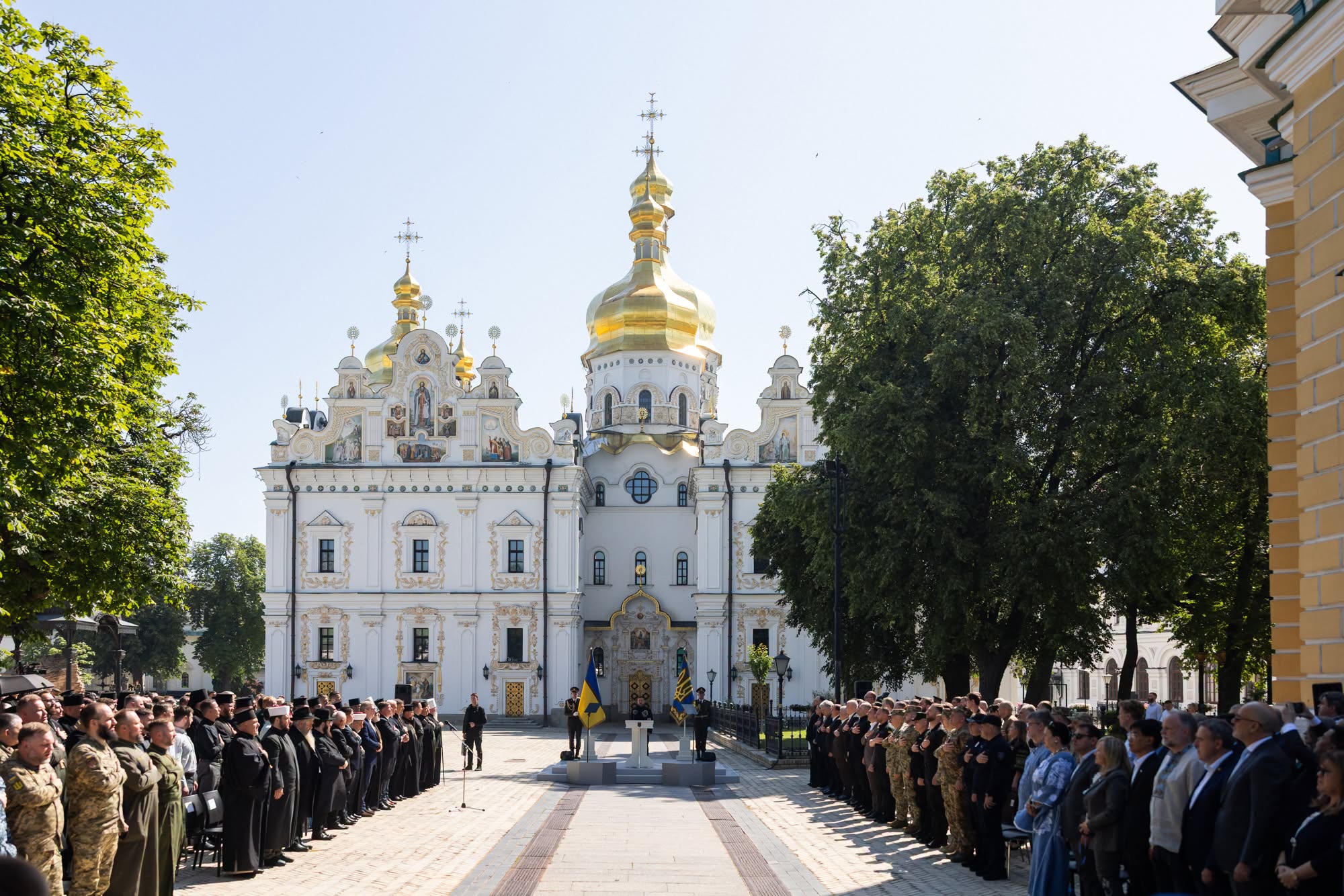
These are all people who are waging war against the Church, or with whose silent consent it has become possible today. And they gathered at the Lavra not by chance. The Orthodox monastery is for them like a trophy, a symbol of victory over the "Moscow priests."
Why are we writing about this now? Because the Odesa Eparchy reported that the assistant to the rector of the cathedral, Archpriest Myroslav Vdodovych, participated in this event "at the invitation of the state." He himself showed footage with Dumenko, Zelensky and others beside whom he was seated. And he accompanied this with an overly formal, official comment, which suggests that he attended an important event among highly respectable people. In other words, a priest of the Odesa Eparchy is interacting with those who persecute his Church, and sees this only as a reason for pride.
And for the Odesa Eparchy, this is not an unfortunate misunderstanding — it is a pattern. Let us look at Odesa through the eyes of an ordinary believer.
Today the entire UOC is experiencing unprecedented persecution. Churches are being taken from us, priests are being beaten, criminal cases are being opened against clergy, and people are being humiliated simply for remaining faithful to their Church. Virtually every eparchy today bears its own pain, and millions of parishioners live with a deep sense of injustice.
Against this backdrop, the Odesa Eparchy appears completely different.
Setting aside the recent case of the seizure of one of Odesa's churches, which was the first of its kind in the entire period, one gets the impression that everything happening has barely touched the Odesa faithful. The problems that other eparchies face daily do not arise here; the persecution is not as severe as elsewhere. Priests are almost never detained on the streets, and eparchial projects continue to operate without interruption.
More than 300 UOC churches across Ukraine have been fully or partially destroyed by shelling. But only the Odesa cathedral receives demonstrative patronage from the state. Only here, after a Russian missile strike, does the President arrive, along with ministers and foreign politicians. The eparchy's clergy calmly receive them, conduct tours, communicate, and raise funds for restoration. And all the while, the authorities have never once recalled that the Transfiguration Cathedral in Odesa belongs to the "Moscow Church" and is under "spiritual occupation."
There is nothing like this in any other eparchy of the Ukrainian Orthodox Church. It is so unusual that people inevitably begin to ask why this is happening.
In Odesa, they say that all of this is thanks to Metropolitan Agafangel. That he has so wisely built relations with the authorities that everything in the eparchy is calm: churches are not taken, work continues, and everything is functioning.
But then another question inevitably arises. Does this mean that the other bishops were unable to do the same? Does it follow that His Beatitude Onuphry proved less far-sighted? That all the other bishops were less wise? Can it really be that only one bishop out of more than a hundred managed to find the right path, while the entire rest of the Church proved incapable of doing so?
It is unlikely that the eparchy itself is trying to present the situation in exactly this way, but statements of this kind do lead to such conclusions.
But people are not blind. They understand perfectly well that in today's Ukraine it is impossible to enjoy such exceptional loyalty from the state "for nothing."
Therefore, the faithful begin to search for explanations on their own. When they see footage of priests standing alongside those they regard as persecutors of the Church, when they see clergy engaging in friendly interactions with representatives of the OCU, when one of the clerics begins actively promoting the issue of autocephaly, a topic that is extremely painful for the Church, people inevitably form a certain picture. They begin to connect all these facts and draw the conclusion that the eparchy's special position has been made possible through certain arrangements with the authorities. That the eparchy's clergy are doing what the authorities today find pleasing, for example, "going after" pro-Moscow bishops and pushing the idea of autocephaly.
Some even claim that Metropolitan Agafangel is only a nominal head of the diocese, while it is actually run by a "media wing" allegedly linked to the SBU. Of course, all of this may be nothing more than absurd speculation. But there are formal grounds that seem to encourage such assumptions. Why does the Odesa Eparchy have such close ties with the state unlike any other UOC eparchy? Why does Archdeacon Andrei Palchuk travel between "pro-autocephalous" bishops and publicly criticize those who hold different views?
These are questions many people ask behind closed doors but hesitate to say out loud. Kokhanovska, on the other hand, is used to speaking her mind, often in a sharp and, in this case, rather rude manner. When she addressed representatives of the OCU in this tone, it went largely unnoticed. Now, Viktoria has begun communicating in the same way with the UOC clergy as well.
Should it have been answered with excommunication? Was it necessary to “declare war”? Or would it have been better simply to clearly and consistently present one’s position and demonstrate that she was mistaken and behaving improperly?
The Church is expected to show mercy, not vengeance
In 2012, a scandal occurred in Moscow: members of the group Pussy Riot staged a blasphemous “punk prayer” on the ambo of the Cathedral of Christ the Saviour, singing the song “Mother of God, drive Putin away.” As the participants later stated, their action was intended as criticism of the close ties between the Russian Orthodox Church and the state.
For this event they received real prison sentences, in which the ROC bore considerable "responsibility," having taken a rather hard line toward Pussy Riot at the time. Patriarch Kirill stated that "the Church has sufficient strength to forgive... but forgiveness must not be perceived as encouragement of the act." According to him, the action was a "battle test" of the position that "the Orthodox will endure anything," which must not be allowed. The then-head of the Synodal Department for Church and Society Relations, Archpriest Vsevolod Chaplin, stated that the action was "a grave sin" and that "Christians must not tolerate blasphemy."
Was the ROC right in such an assessment? It was: Pussy Riot did indeed commit blasphemy. But here is the paradox: the authority of the Russian Church in society suffered greatly from this story. For example, DDT frontman Yuri Shevchuk said that "this is not the Orthodox way."
Why is that? People subconsciously expect from the Church not strict justice or the letter of the law, but mercy. Because this is how Christ acted.
"Sacred war" within the UOC
Metropolitan Agafangel’s decree has triggered a real confrontation within the UOC. One hierarch calls the human rights activist a “hysterical troublemaker” and a “vulgar woman,” another describes her as “pro-Moscow” and “an unstable person,” while a third says that Kokhanovska is “actively discrediting our Church.” Supporters of the human rights activist, in turn, apply even harsher labels to her opponents.
The level of tension is rising, and the whirlpool is drawing in more and more participants, even those who do not wish to be involved. For example, Archdeacon Andrei Palchuk stated that, contrary to Metropolitan Agafangel’s decree, Kokhanovska was still given Holy Communion at the Vvedensky Monastery. In doing so, the archdeacon indirectly implicated the abbot of the monastery, Archbishop Damian, in the conflict.
However, according to the UOJ, this does not correspond to reality: Viktoria was indeed given Communion in Kyiv, but in a different church. Nevertheless, the information has already been widely circulated on social media.
One bishop is strongly hinting that behind Kokhanovska in the UOC episcopate allegedly stands a patron who needs to be removed. And everyone can guess who is meant. But again, there is no evidence to support such claims. Meanwhile, instead of repentance, Kokhanovska launches a new wave of attacks against Odesa, accusing it of interference in the affairs of the Zaporizhzhia Eparchy. Tension is growing every day, at a time when pressure on the Church is not easing but only intensifying.
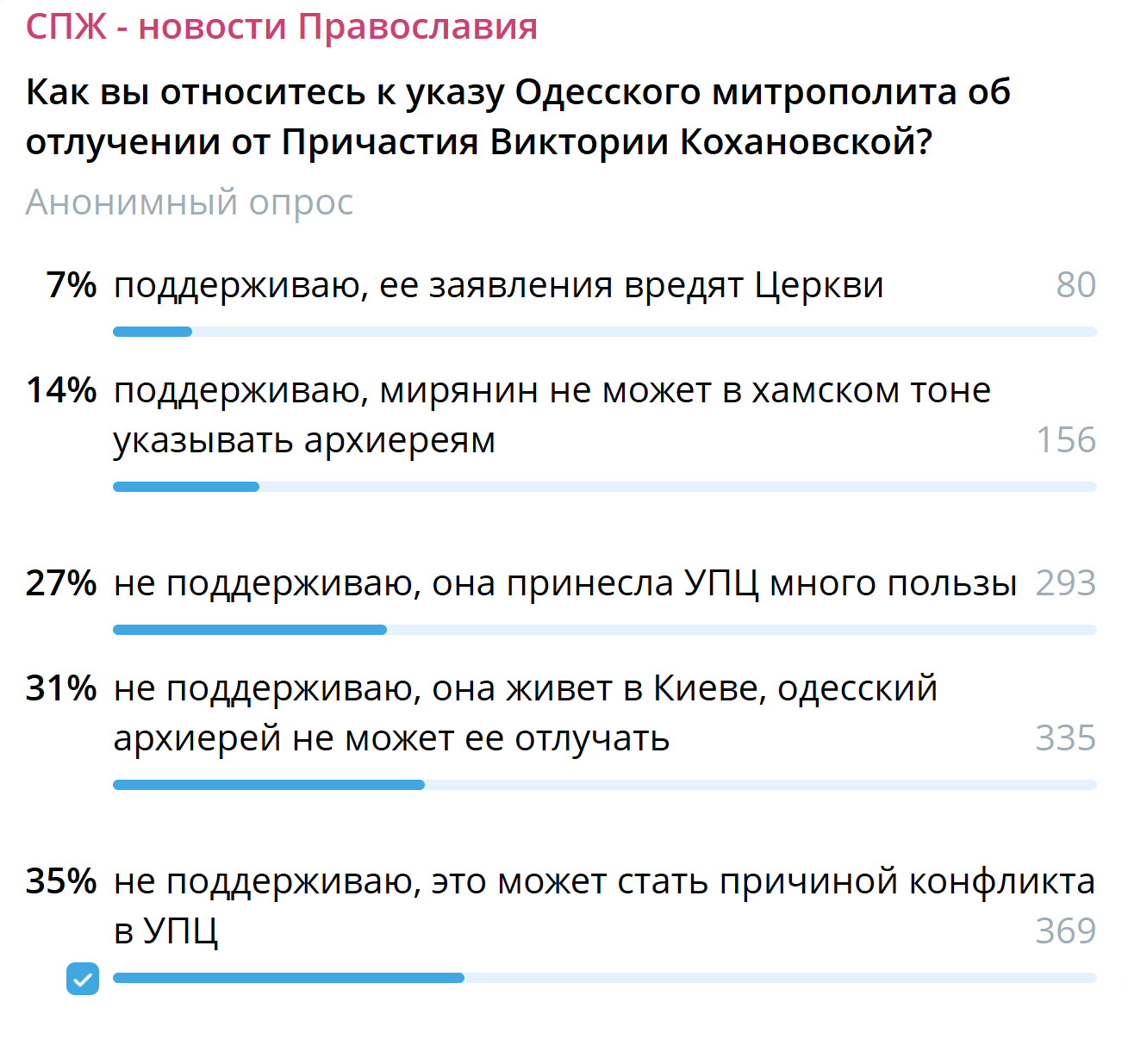
How ambiguous the situation is can be seen, for example, from the reaction of UOJ readers on Telegram. Around 1,100 people took part in a poll on the channel, and the overwhelming majority spoke out against the excommunication. Only a few approved it: 7% believed that Kokhanovska’s statements harm the Church, and another 14% said that a layperson has no right to lecture bishops in a rude tone.
The rest were opposed. The largest share of votes – 35% – went to the answer that, in essence, captures the main tension of the entire story: such a step could become the cause of a new conflict within the Church.
This is also addressed by the lawyer of the Kyiv Metropolis, Archpriest Nikita Chekman, in an alarming message in which he calls on the episcopate, clergy and faithful to put an end to divisions and conflicts.
"Today, when our Church is going through difficult times, mutual love, humility and unity are needed as never before. We must learn to ask forgiveness and to forgive one another. For it is precisely division that the enemy of the human race seeks. Any internal conflicts only weaken us and bring joy to those who wish our Church harm," writes Father Nikita.
And here it is worth returning to the conversation between His Beatitude Onuphry and Metropolitan Agafangel, in which the Primate urged him not to react to Kokhanovska and not to take any action. Did this appeal mean that Metropolitan Onuphry approved of her boorishness? Or that he did not respect the episcopal dignity of the Odesa Metropolitan? Certainly not. His Beatitude simply knew that such actions would lead only to an outburst of emotions, polarization and division. And he was not mistaken.
In the situation with this phone conversation, there is another important point: in effect, Metropolitan Agafangel disregarded the advice of His Beatitude. We do not write that he “disobeyed the will” of the Primate, but it is roughly the same thing.
What is to be done?
This article was not written to assign blame. In such stories, everyone is sincerely convinced that they are defending the Church — the metropolitan who signed the decree, the human rights defender herself, and those who rushed to argue on social media. The trouble is that our righteous anger and our sense of being right too often work not for the Church but against it.
The Church is not simply a community of like-minded people that can be strengthened by punishing those who disagree. It is the Body of Christ. And there are forces outside it that seek its destruction at any cost: churches are being taken away, criminal cases are being opened, priests are being beaten. But the most dangerous thing is when these forces receive help from within when we ourselves, without noticing it, become instruments of division, which is exactly what the enemy seeks.
Let us recall: after the strike on the Lavra, His Beatitude was again reproached: they said he was silent again, that he "only prays" again. But is this not precisely true pastoral wisdom? Today, when war is ongoing and the Church is being destroyed, every word of ours must be examined carefully, because “we are not given to foresee how our word will respond.” And if there is no certainty that it will respond with love, it is better to remain silent.
Metropolitan Onuphry understood this when he advised not to respond to Kokhanovska not because he approved of her sharpness, but because he knew what the response would bring. And he was not mistaken.
Kokhanovska was expected to show repentance, Odesa was expected to act with prudence. But louder than either of these today is exactly what the enemies of the Church set out to achieve: that we strike our own. And as long as we are striking, they are winning.