
Financing churches with Ukrainians' taxes – what are the prospects?
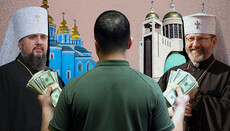
An MP has proposed introducing a church tax in Ukraine. How do similar systems work in Europe, and what consequences could they have in our country? Let us take a closer look.
Ukrainian MP Mykyta Poturaev, known for his antipathy toward the UOC, has proposed financing religious organizations through tax mechanisms.
“The idea is to allow Ukrainian citizens to support, through their taxes, those religious organizations they consider worthy. This is a model that is widely used across Europe,” Poturaev stated.
The idea sounds attractive. Give citizens the right to direct part of their taxes to religious organizations they support. Yet behind the appealing rhetoric lies a question that is far more important than the mechanism itself: who will decide which churches deserve public money?
In stable democracies, church-financing systems emerged over centuries and function within robust legal frameworks. In Ukraine, however, such a model is being proposed at a time when one religious community faces lawsuits, administrative pressure, hostile media campaigns, and attempts to curtail its activity. Under these circumstances, the initiative could become not a tool of religious freedom but another instrument of political influence.
European models of church financing
These models generally fall into four categories:
- A church tax for members of specific religious communities;
- Taxpayers choose a recipient from a state-approved list;
- Direct budgetary support for clergy;
- No tax-based financing mechanism.
1. Church tax or contribution for members of specific religious communities
The best-known example is Germany. There, the church tax, Kirchensteuer, is paid not by all citizens but only by members of officially recognized religious organizations. In most federal states, the rate amounts to 9% of the assessed income tax.
With an average annual gross salary of around €53.8 thousand, this amounts to approximately €640–900 per year.

The financing scheme works as follows: a person officially declares to both the employer and government authorities his or her affiliation with a particular denomination. The employer withholds the church tax together with income tax. Tax authorities collect the funds and transfer them to the corresponding religious organization, retaining an administrative fee.
It is important to understand that the taxpayer cannot designate a specific parish or monastery. The funds go to the religious organization as a whole, which then distributes them according to its own internal rules.
Interestingly, the Local Orthodox Churches registered in Germany generally rely on donations rather than collecting church tax from their faithful, even though they are entitled to do so.
The main reason is the absence of a tradition of rigid formal membership and the financial and other obligations associated with it.
Similar systems exist in Austria, Denmark, Sweden, and other countries.
Finland also belongs to this group, but with one notable distinction: believers register not as members of a denomination but as members of a specific parish, which then receives their church tax.
2. Taxpayers choose a recipient from a state-approved list
In this model, the church tax is not an additional levy on top of income tax. Instead, it is a percentage of the income tax itself that the taxpayer may allocate to a religious organization.
For example, Italy operates the otto per mille system – “eight per thousand,” or 0.8% of income tax. In absolute terms, this amounts to only several dozen euros per person, but collectively it generates millions of euros, most of which go to the Catholic Church.
If a taxpayer indicates which religious organization should receive the funds, that organization receives them. If no choice is made, the money is distributed proportionally according to the preferences of those who did make a selection.
Spain has a similar model, though with its own characteristics. Taxpayers may direct 0.7% of their income tax either to the Catholic Church or to social causes. They may choose both options or neither. However, they have no influence over the specific allocation of the funds. Distribution is handled either by the Catholic Church or by the state. Comparable allocation models operate in Hungary and Romania.
3. Direct budgetary support for clergy
The clearest example is Greece. The state directly finances the Church of Greece from the national budget, including the payment of clergy salaries. For example, approximately €200 million was spent for this purpose in 2023.
Under this model, taxpayers have no influence whatsoever over the allocation of their taxes. They simply pay mandatory taxes into the state budget.
A similar system exists in Belgium, where the state finances officially recognized religions. Norway also follows a comparable approach, with the Lutheran Church of Norway receiving the bulk of funding, while registered religious and philosophical communities may apply for state grants.
4. No tax-based financing mechanism
France, the Netherlands, and a number of other countries do not have a church tax or any other mechanism for regular tax-based financing of religious organizations. Religious communities are supported primarily through donations, the use of their own property, internal collections, and similar means. At the same time, the state or municipalities may provide funding for social projects, the restoration of historic buildings, and related activities.
None of these models is perfect. Even in Europe, their substantial shortcomings are openly acknowledged.
Drawbacks of state financing for religious organizations
Formalization of religious affiliation
Faith becomes a tax status.
A person cannot remain a believer while refusing to pay the church tax. For example, the Catholic Church in Germany explicitly states that one cannot leave only the “church corporation” while retaining full membership in the Church’s “spiritual community.” In practice, the message becomes something like: either pay, or you are no longer Catholic.
This may be one of the reasons why more than 300,000 Catholics officially leave the Church in Germany every year.
The other side of this phenomenon is that many people who pay the church tax begin to regard participation in worship and parish life as unnecessary.
Dependence on state structures: “He who pays the piper calls the tune”
Perhaps the greatest danger lies elsewhere.
A church that depends on the state for its financial survival inevitably becomes vulnerable to state pressure.
The principle is simple: whoever pays expects influence. Churches that rely heavily on government resources often find it difficult to challenge prevailing political agendas. Across Europe, many Christian communities have faced pressure to adapt to social and ideological trends that they previously opposed on doctrinal grounds.
Thus, Churches are compelled either to remain silent or to declare that Holy Scripture is outdated and adjust its norms accordingly.
Financial support rarely comes without expectations.
Sooner or later, those who control the money begin to influence the message.
Discrimination against unregistered religious organizations
In many European countries, registration procedures for religious organizations are cumbersome and highly bureaucratic. Religious groups are often denied registration for unclear reasons. In some countries, obtaining funding requires not only registration but also the conclusion of separate agreements with the state.
As a result, only a limited number of churches receive funding, creating risks of discrimination. Even the European Court of Human Rights has pointed to this problem. Even the European Court of Human Rights has pointed to this problem.
Lack of transparency in the distribution of funds
Transparency presents yet another challenge. Large sums of public money inevitably raise questions about who controls distribution, who benefits, and how decisions are made.
There is also the issue of corruption. Whenever budget money enters the picture, so do questions about influence, lobbying, and personal interests.
Who will determine eligibility?
Who will oversee distribution?
Who will audit expenditures?
Who will decide which projects deserve funding and which do not?
Given Ukraine's long struggle with corruption, these questions cannot simply be brushed aside. A mechanism presented as support for religious freedom could easily become another channel for political favoritism and financial abuse.
What would this imply for Ukraine?
Let us now return to Poturaev’s proposal. This is where the European experience ceases to be reassuring.
In Ukrainian realities, such a model would inevitably become fertile ground for abuse. And here is why.
First, the fundamental question is not whether church taxes can work in principle. The question is whether they can work fairly in today's Ukraine.
Who would determine which religious organizations qualify for state-supported funding?
Not believers, but government officials, who have clearly demonstrated that they distinguish between "acceptable" and "unacceptable" churches.
Indeed, Poturaev effectively said as much himself when he stated that funding would go to the “necessary” churches, specifically naming the OCU and the UGCC.
Second, the Ukrainian Orthodox Church – still the country's largest religious denomination – would almost certainly find itself excluded. The State Service for Ethnopolitics and Freedom of Conscience has already declared the UOC affiliated with the Russian Orthodox Church and initiated legal proceedings seeking its prohibition.
Third,
financial incentives could be used to encourage transfers from one religious jurisdiction to another. Ukraine has already witnessed disputed re-registrations of communities, controversial parish meetings, and violent church seizures. Adding financial benefits to this environment would likely intensify conflict rather than reduce it.
Fourth, any church-tax system requires citizens to identify their religious affiliation. In practice, this would create official databases showing exactly which church every participating taxpayer supports. In a country where religious divisions are already politically charged, such information could easily become a tool of pressure.
Fifth, such a system would create vast opportunities for corruption. The fact that funds would be distributed according to the internal decisions of church structures would, in Ukrainian conditions, likely result in kickbacks, abuses, and other forms of “budget appropriation.”
Sixth, churches would become heavily dependent on the state. And Ukraine's authorities have already shown a willingness to intervene in church affairs.
If religious organizations become financially dependent on government decisions, the temptation to demand political compliance will only grow stronger. For example, Viktor Yelensky has already expressed confidence that the All-Ukrainian Council of Churches and Religious Organizations will respond with understanding to the need to introduce an LGBT agenda in Ukraine.
Conclusion
European church-financing systems emerged through centuries of church-state relations and function within mature democratic institutions protected by independent courts and strong guarantees of religious liberty.
Ukraine's circumstances are entirely different.
The proposal comes amid an ongoing religious conflict, legal pressure against the country's largest confession, growing state involvement in ecclesiastical affairs, and a political culture where expediency too often prevails over principles.
Under such conditions, a church tax would be unlikely to strengthen religious freedom.
Far more likely, it would deepen divisions, increase state control over religious life, and provide new opportunities for corruption.
The real danger is not that Ukrainians might support churches through their taxes.
The real danger is that the state may decide which churches deserve that support – and which churches do not.