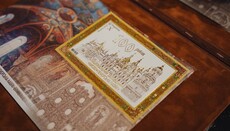

Scholars restore 42 pages of Apostle Paul's lost letters
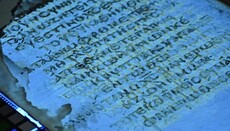
Researchers discovered unique commentaries on Scripture and reconstructed an ancient system of chapter divisions.
An international team of experts led by the University of Glasgow has successfully recovered dozens of pages from Codex H, one of the oldest New Testament manuscripts. Ancient Origins reports that these parchment leaves contain the Letters of the Holy Apostle Paul and unique commentaries on them.
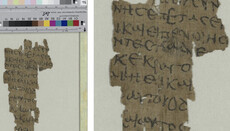
In the 13th century, monks at the Great Lavra on Mount Athos disassembled the ancient manuscript. Since durable parchment was expensive at the time, the codex pages were repurposed to bind other books. As a result, fragments of the manuscript were scattered across libraries in Greece, Italy, France, Russia, and Ukraine, with many pages long believed to be permanently lost.
The specialists used cutting-edge multispectral imaging. This technique captures the manuscript under multiple wavelengths of light – from ultraviolet to infrared – revealing ink traces invisible to the naked eye.
As Professor Garrick Allen explained, chemicals in the ink left “imprints” on neighboring leaves. Scholars were able to retrieve these “ghost” texts and reconstruct the contents of each surviving page.
The discovery reveals details about how Christians studied Scripture in the early centuries. The text contains an ancient system of chapter divisions, markedly different from that of the modern Bible. The pages also include scribal notes and historical references that helped believers understand the meaning of the epistles.
Professor Allen described the significance of the find in striking terms: "Given that Codex H is such an important witness to our understanding of Christian scripture, to have discovered any new evidence, let alone this quantity, of what it originally looked like is nothing short of monumental."
Earlier, the UOJ reported that archaeologists hope to find the Ark of the Covenant in Jerusalem.