
UOC Chancellor comments on celebrations at Phanar attended by the Pope

Metropolitan Anthony emphasized that for the Church, true unity is possible only in the truth of Christ, not in a fusion of truth with error.
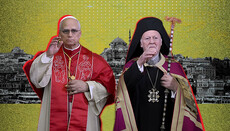
The celebrations at the Phanar marking the anniversary of the First Ecumenical Council and attended by the Pope should be viewed as yet another episode in the Ecumenical Patriarch Bartholomew’s violations of Orthodox canonical rules, stated Metropolitan Anthony of Boryspil and Brovary, Chancellor of the UOC.
According to the hierarch, the “Nicaea celebrations” were only partially connected to the commemorated date – the 1700th anniversary of the First Ecumenical Council. “It is important to remember that the Council of Nicaea was not only a symbol of external agreement, but above all a triumph of Orthodox truth over Arian error,” he noted.
“Today, the word ‘unity’ is often used in a very broad and frequently undefined sense. Yet for the Church, true unity is possible only in the truth of Christ and in devotion to the Gospel, not in blending truth with error or attempting to reconcile what cannot be reconciled,” the UOC Chancellor stressed.
Metropolitan Anthony noted that Orthodox Churches have for many years observed with concern the canonical violations committed by the Phanar, but out of a desire to preserve ecclesial unity have treated them leniently. “Our Church has now experienced the consequences in full: the acceptance into its jurisdiction of a structure that Patriarch Bartholomew himself had long referred to as schismatic, without repentance on the part of its members and without proper ordination, became the final point,” the hierarch stated.
He said that the legalization of the schism in Ukraine is neither a mistake nor an “unfortunate accidental episode,” but the result of nearly a century of deliberate and consistent actions by the Patriarchate of Constantinople.
He also drew attention to calls asserting that the UOC must urgently “establish contacts” with the Patriarchate of Constantinople. According to Metropolitan Anthony, such appeals require very careful and responsible theological consideration.
“To avoid losing one’s way amid the multitude of voices and initiatives of our time, it is important for a Christian to turn again and again to Holy Scripture, to the writings of the holy fathers, and to the Church’s canonical Tradition,” the hierarch concluded.
Earlier, the UOJ analyzed why the absence of the filioque in the Creed read by the Pope at the Phanar does not indicate the Roman Catholic Church’s willingness to abandon its doctrinal errors.