
Did Patriarch Bartholomew really mourn Filaret’s death?
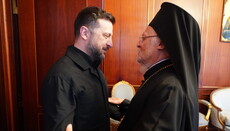
In the official readout of his latest meeting with Patriarch Bartholomew, Zelensky claimed that the Patriarch had expressed condolences over Filaret’s death. More than that, Denysenko was identified by the title used in the OCU: “The Ecumenical Patriarch Bartholomew expressed condolences in connection with the death of the Honorary Patriarch of Kyiv and All Rus-Ukraine Filaret.”
But can this really be believed?
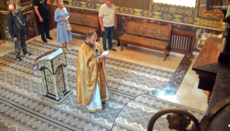
In the life of the Church, the deepest condolence is not a diplomatic phrase – it is prayer. Patriarch Bartholomew himself showed as much at the funeral of the Georgian primate in Tbilisi. And yet at Filaret’s burial there was not a single hierarch from the Phanar. Not one. Even Bishop Michael of Comana, the Constantinopolitan exarch in Kyiv, was absent – though he routinely appears beside Epifaniy even at the most ordinary services. His pointed absence from Filaret’s funeral looked too deliberate to be accidental. It looked like a signal. Or rather, like a prohibition.
And there is an even more awkward detail. Constantinople never recognized Filaret as patriarch in any form at all. So the idea that Bartholomew would suddenly use precisely that title – and in such a politically loaded moment – strains belief to the breaking point.
Then there is the simplest fact of all: the official communiqué published by the Patriarchate of Constantinople after the meeting says nothing whatsoever about condolences. Not a word.
So what most likely happened?
It is doubtful that the President’s Office invented the entire episode from nothing. Filaret was almost certainly mentioned in conversation. But the likeliest scenario is far less dramatic: Zelensky brought up Denysenko’s death, and Bartholomew responded with little more than a polite gesture, perhaps a sympathetic nod. And from that small, vague moment, an entire line was crafted for the public record.
Why would such a line be needed?
Because the silence surrounding Filaret’s funeral was too glaring. The absence of hierarchs from the Local Churches at the burial of the founder of the supposedly “fully recognized autocephalous church” was impossible not to notice. That silence had to be softened. Explained away. Covered over, at least a little.
So the condolence formula appeared – less as a fact, it would seem, than as a piece of political damage control.
Whether it convinced anyone is another matter.
But the President's Office attempt itself was revealing.