
Six bronze figures on the road to their Gethsemane
We are used to heroic monuments celebrating triumph. Auguste Rodin shows us a different kind of heroism – the courage of a person walking toward death to save others.
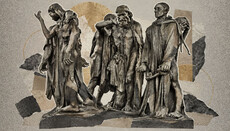
Looking at Auguste Rodin’s sculptural group The Burghers of Calais, we see six gaunt figures standing barefoot in tattered shirts, with loops of coarse rope around their necks.
The story behind the work unfolded in August 1347. After a brutal siege, King Edward III of England agreed to spare the starving French city of Calais – but imposed a merciless condition. Six of the city’s most prominent and wealthy citizens were to walk into the enemy camp dressed only in their undergarments, carrying the keys to the city gates and wearing ropes around their necks, ready to be publicly executed. Sir Eustache de Saint-Pierre was the first to volunteer for this public humiliation. He was followed by Jean d’Aire, the brothers Jacques and Pierre de Wissant, Jean de Fiennes and Andrieu d’Andres.
The French chronicler Jean Froissart preserved the words of Eustache de Saint-Pierre, who expressed his trust in the Lord’s mercy as he sought to save his fellow citizens from death. Rodin shows us these men at the very moment when they believe they are taking their final steps on this earth.
A revolt against heroic grandeur
The story of the monument’s creation is one of conflict between the sculptor and those who commissioned it. In 1886, the Calais municipal committee flatly rejected Rodin’s model. Officials were outraged by its lack of conventional grandeur. In the official minutes, committee members complained that the dejected poses of the emaciated townsmen and the absence of an elegant silhouette “offended their religion.” But theirs was the secular religion of nationalistic grandeur and heroic exaltation – far removed from genuine spirituality.
Rodin’s letter in response to the mayor of Calais became a manifesto against false art. The sculptor categorically refused to shape the figures according to academic conventions. Even at a glance, it is clear that the monument lacks the hierarchy typical of its time. All six craftsmen and merchants stand on the same level.
Rodin deliberately sculpted their bodies as frail and emaciated by months of starvation, giving physical form to their suffering.
The sculptor exaggerated the proportions of their hands and feet. Their enormous hands and massive feet seem to anchor them to the earth, conveying the weight of the decision they have made. Andrieu d’Andres covers his face with his hands in despair. The young Jean de Fiennes stands with his palms spread helplessly and his mouth slightly open. Jean d’Aire grips the keys to the city tightly, his jaw clenched in silence.
Rodin said he deliberately positioned the figures apart from one another because, at the moment of a terrible choice, every person ultimately stands alone with his conscience and his fear of death.
An echo of Gethsemane
Looking at the bare feet of the townsmen, seemingly reluctant to take another step, we begin to see the profound Christian meaning of the work. Rodin unexpectedly came close to the very heart of the Gospel story.
Holy Scripture reveals the highest expression of human love: “Greater love hath no man than this, that a man lay down his life for his friends” (John 15:13). But the road to such a sacrifice is never easy or painless. Recall the Savior’s prayer in the Garden of Gethsemane on the eve of His Passion: “And he went a little farther, and fell on his face, and prayed, saying, O my Father, if it be possible, let this cup pass from me: nevertheless not as I will, but as thou wilt” (Matt. 26:39).
Christ’s human nature trembles before death. The fear and anguish of His flesh do not diminish the voluntary nature of His sacrifice – on the contrary, they reveal the tremendous price of it.
The bronze burghers of Calais are also terrified of death. Their swollen feet seem to claw desperately at the earth. Their spirits urge them to fulfill their duty, while their flesh recoils in terror. Rodin portrayed living human beings overcoming their fear for the sake of saving the other inhabitants of their city. It is precisely this agonizing struggle between human frailty and the fervor of the spirit that makes their heroic act truly great.
Statues brought down to the people
Rodin desperately wanted to dispense with the traditional high pedestal for his monument. He dreamed of placing the bronze figures directly on the cobblestones of the square in front of Calais City Hall, embedding them in the pavement so that passersby might brush against their bronze garments with their elbows and, through that physical contact, feel that even ordinary life leaves room for acts of self-sacrifice.
In 1895, those who commissioned the monument failed to grasp the brilliance of this idea and placed the group atop a five-meter granite pedestal surrounded by a railing. It was not until 1924 that the sculpture was finally moved to the city hall and placed on a low base, fulfilling the artist’s wishes.
The bronze burghers of Calais remind us that the human heart can be tormented and terrified of death – and still, despite everything, take the decisive step toward self-sacrifice.