
The “mystery” of the Entry
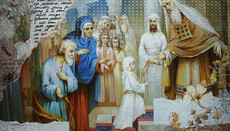
The Entry of the Most Holy Theotokos into the Temple is one of the most mysterious and profound feasts of the liturgical year. Nothing about it is mentioned in the New Testament, and not a single historical document confirms its factual occurrence. The feast is rooted in an apocryphal text – the Protoevangelium of James – written around the year 150 after the Nativity of Christ.
From the standpoint of external logic and Jewish law, such an event is impossible. And yet it firmly entered the Holy Tradition of the Church. Therefore, we speak of it not on the historical plane, but on the ontological and mystical one. Only this level grants us a proper understanding of the feast’s meaning.
Metaphysics
The Entry of the future Mother of God into the Jerusalem Temple is a point of bifurcation in Sacred History – a moment when the Old Testament had already ended, while the New had not yet begun. Until then, the God of Israel was present in a specific place: the Jerusalem Temple, the Holy of Holies, the Ark of the Covenant. With the Virgin Mary’s entrance, a metaphysical substitution occurs. The space into which God will descend will no longer be the Ark, but the body of this young Maiden.
The Jerusalem Temple was a model of the universe, just as our Orthodox church building is today.
God contains all creation within Himself, yet no creature can contain God. The Entry of the Virgin into the Temple marks the beginning of a cosmic event of unimaginable scale. Into the earthly sanctuary enters She who will become the living vessel of the Creator Himself.
Thus, in theology, the person of the Theotokos is expressed through a paradox: She is Χώρα τοῦ Ἀχωρήτου – the “Space of the Uncontainable.” God prepares for Himself a body, that He might cease to be a distant, transcendent Absolute and become a Person in the flesh. With the Virgin’s entrance into the Temple, the Old Testament recedes into the realm of shadows.
From the perspective of sacred geometry, the Holy of Holies is a perfect cube – a space designated as the “dwelling” of God. It is the realm of that “super-luminous darkness of silence,” as Saint Dionysius the Areopagite calls it – the divine darkness into which Moses entered upon Mount Sinai (Ex. 20:21). In this darkness, the mind grows silent, and the spirit speaks.
Mary enters the realm where the categories of space and time fall still, preparing herself to receive the Divine Logos.
God is not known in the “light” of earthly rationality, but in a knowledge beyond knowledge – where the mind relinquishes earthly representations and descends experientially into the divine darkness of silence.
The Entry is a departure from the realm of worldly agitation into the realm of contemplation. In ancient philosophy, Aristotle considered the contemplative life the highest good. In Christianity, this truth is transfigured: the Virgin does not withdraw from the world for idle rest, but for sacred stillness, that she may become the Mother of the Word. And for the Word to sound, there must first be Silence.
Philosophy
The Feast of the Entry is humanity’s answer to God. If Adam’s fall was humanity’s refusal to be a priest, then the ascent of the three-year-old Maiden into the Holy of Holies is the restoration of the priesthood of mankind.
The Theotokos is the ultimate goal of cosmic history. The universe unfolded over billions of years, humanity lived for millions, countless generations of the righteous labored, purified themselves, suffered, fell, and rose again – all for one single purpose: that She who could become the Mother of the Son of God might enter the world.
Asceticism
Saint Gregory Palamas dedicated one of his homilies to the Feast of the Entry, and from it he built an entire Orthodox theory of knowledge. For him, the Entry is a manifesto of prayer. In this image, the Jerusalem Temple is the human person: the outer court is the body, the sanctuary is the soul, and the Holy of Holies is the spiritual heart – the deep core of the human person.
Saint Gregory teaches that the Theotokos, dwelling in the Holy of Holies, rose not only above sensory perception but also above discursive thinking – that is, sequential, logical reasoning. The Virgin abided in unceasing contemplation of God, free from every thought.
Thus the saint, an experienced spiritual practitioner, teaches that to unite with God it is not enough to purify the senses – one must transcend the mind as well. Our intellect divides reality, analyzes, works in images. The Virgin leaves this lower level behind. In the Holy of Holies there were no images, statues, or icons. There was only emptiness – the ideal space for imageless, noetic prayer. The “food” brought to Her by the Archangel Gabriel symbolizes the direct participation in Divine Energy.
The Theotokos rejected all created things – sight, hearing, memory of the world. She entered “nothing” in order to find “Everything.”
This is the classic path of hesychasm – through renunciation of all things to attain the Infinite.
The Virgin achieved deification (theosis) even before the Annunciation, through her ascetic labor in the Holy of Holies. Thus she prepared her body and soul to become the instrument of the Incarnation through the absolute purity of her mind.
And from here follows a crucial conclusion: for God to be born in you, you must enter the Holy of Holies of your own heart, closing the doors of the senses and silencing the stream of thoughts.
Practical guidance
- Silence. To be saved in God, one must step out of the world. Not necessarily into a monastery, but into an inner exodus from the noise, commotion, and informational chaos. The soul must discover its own sanctuary of silence.
- The path. To reach the Holy of Holies, one must pass through the outer court – the path of fulfilling the commandments and battling the passions.
- Sacrifice. One must learn to let go of everything. Saints Joachim and Anna give to God what is most precious to them. This is an example for all of us. We own nothing in this world – not our children, not our talents, not even our very lives. Everything must be returned to the Source. “Thine own of Thine own” is the liturgy of our life – offering back to God what in truth already belongs to Him.
The Feast of the Entry teaches that the goal of Christian life is not merely visiting a stone temple, but becoming a living temple. It is also a feast of silence before the Great Mystery – a reminder that “being” is greater than “doing,” grace greater than rule, the inner greater than the outer.
The modern world is obsessed with activism. But the Feast of the Entry shows that the greatest action in history – the Incarnation of the Word – was prepared by years of absolute silence and prayerful concentration. The same is true for the salvation of our own souls. The task of life is not to remain in the “outer court” of external or carnal existence, but to enter the inner sanctuary of the mind, where the unceasing liturgy of the Spirit is celebrated.
The Church is that which leads a person into the Holy of Holies – not that which remains in the outer courtyard of ritual and religious services.
The Feast of the Entry of the Most Holy Theotokos reveals the very technology of salvation. It shows that God does not descend into the human heart mechanically. He waits until our nature, by the effort of its will and in the space of silence, creates a pure vessel – free from passions and thoughts – into which the grace of the Holy Spirit may descend.