
UOC Primate: We must live so that our descendants remember us with love
On the Sunday of the Holy Fathers, His Beatitude reminded the faithful that the Lord came to save not only the righteous, but sinners as well.
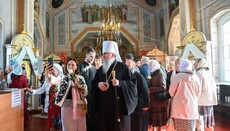
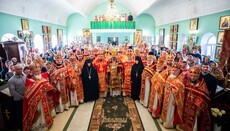
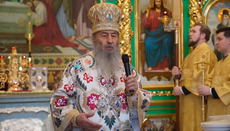
On January 4, 2026, the Primate of the Ukrainian Orthodox Church, His Beatitude Metropolitan Onuphry, celebrated the Divine Liturgy at the Agapit Church of the Kyiv-Pechersk Lavra and delivered a homily in which he reminded believers of the profound meaning of the Gospel genealogy of the Savior.
The hierarch drew attention to an unusual feature of the genealogy recorded by the Evangelist Matthew: contrary to the Jewish tradition of tracing ancestry only through the male line, it mentions four women – Tamar, Rahab, Ruth, and Bathsheba.
“All four of these women were not examples of impeccable conduct. They were sinners. And Ruth was not even a Jewess – she was a Moabitess,” Metropolitan Onuphry noted.
The Primate then recounted the story of each of these women in detail. Tamar was the daughter-in-law of the patriarch Judah, who through cunning ensured that she would become part of the Messiah’s lineage; she bore twins, Perez and Zerah. Rahab was a resident of Jericho who sheltered Israelite spies and saved her family during the capture of the city. She became the wife of Salmon, and from their marriage Boaz was born.
Ruth was a Moabitess who said to her mother-in-law Naomi: “Where you go, I will go. Your people shall be my people, and your God my God.” She became the wife of Boaz, and among her descendants was King David. Bathsheba was the wife of the commander Uriah, with whom King David committed sin. From that union King Solomon was born, under whom the Kingdom of Israel reached the height of its might.
“The Lord, through the Holy Spirit, through the Apostle and Evangelist Matthew, arranged it this way in order to show that the Lord came to earth to save not only the righteous, but sinners as well,” His Beatitude emphasized. “Not only those who tried to live according to God’s law, but also those who transgressed it, who broke it. The Lord came for the salvation of all people.”
Metropolitan Onuphry added that people usually try to conceal the vices and shortcomings of their ancestors in order to gain glory among men. “But the Lord came to accept the dishonor of His forefathers and to glorify us, making us children of God,” the Primate said.
Concluding his homily, His Beatitude addressed the faithful with an appeal: “May the Lord help us, dear brothers and sisters, to be not the kind of people our descendants would be ashamed of, but the kind whom they would remember with happiness, with dignity, with love.”
Metropolitan Onuphry urged Christians to strive to live according to God’s commandments – commandments that make a person noble, radiant, kind, and able to receive eternal blessedness and life in heaven in Christ Jesus.
Earlier, the UOJ wrote that, in the words of His Beatitude Onuphry, a person deprives himself of God’s gifts when he does not thank God.