
The measure of a fast matters more than its strictness
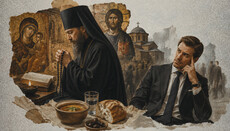
The Typikon lays out a monastic rule for laypeople hour by hour, without showing what its observance should look like in secular life. The proper measure of fasting is found not in the rulebook, but in discernment.
Every August, the same chart makes the rounds in church-calendar chats and mailing lists: Monday, Wednesday and Friday – dry eating; Tuesday and Thursday – cooked food without oil; and only on Saturday and Sunday is there any relaxation at all. At first, such a schedule inspires respect: this is a serious rule, and the Dormition Fast is the second strictest after Great Lent, even though it lasts only two weeks. But very soon the predictable panic sets in: how is anyone supposed to manage this with a job, children and plain old exhaustion?

Before getting alarmed, however, it is worth asking: who was this rule actually written for?
The rule was not written for us
The strict calendar of the Dormition Fast comes from a specific monastic rule that developed at the Monastery of St Sabbas the Sanctified near Jerusalem and was later incorporated into the general Typikon. The Church simply has no separate fasting rule for laypeople.
The strict fast was designed for a monk whose entire day, from morning until evening, is ordered around worship and work within the community. It was certainly not devised for someone who, after a day of dry eating, still has to spend eight hours behind the wheel or at the stove cooking for a family with four children.
Discarding the rule altogether is not the answer either – its strictness carries a deep tradition and meaning. But applying it literally and without discernment to one’s own life is a mistake – one that, incidentally, the very Fathers who formulated these rules warned against.
St John Cassian taught his disciples that one should take care not only to avoid eating too much, but also to eat at the proper time even when one feels inclined to fast more strictly. Excessive abstinence, he wrote, is more harmful than overeating.
St Ignatius Brianchaninov warned even more sharply: an ascetic feat for which the soul is not yet ready does not strengthen a person. It unsettles him and leaves despondency behind instead of grace.
Who can serve as an example for a layperson?
This is where the real difficulty arises. You open the calendar of saints looking for someone to imitate – and find mostly monks, hermits, bishops and martyrs. Their lives often ended heroically, dramatically and quickly. Yet examples of how a layperson should actually fast – while caring for a home, a husband, children and a household – are surprisingly few.
One of the most striking examples is Righteous Juliana of Lazarevo, a 16th-century noblewoman from Murom. She married at sixteen and took charge of a large household. She rose before everyone else in the house and went to bed after everyone else. Even in years of famine she fed the poor, giving away her last morsel of food. She gave birth to thirteen children, most of whom died in infancy, while two of her adult sons were killed in the tsar’s service. After this loss, Juliana asked her husband’s blessing to enter a monastery. But he replied that they first had to raise their remaining children.
She obeyed and stayed. She transferred her spiritual struggle into domestic life: she intensified her fasting and prayer, slept only two hours a night and used a log instead of a pillow.
That detail, of course, should not be turned into a set of instructions – the log is not the point. Far more important is what happened next. When illness and accumulated exhaustion took their toll, Juliana began attending church services less often. Yet her prayer at home only grew more intense. A woman whom the Church glorified precisely for her ascetic life herself changed the form of that strictness when her body could no longer sustain it. For her, the rule was a tool for refining the soul. And like any tool, it can be set aside or replaced when it ceases to be beneficial.
The measure of fasting you won’t find online
This brings us to the practical answer to the question of how strict a fast should be. The proper measure of abstinence for a layperson is not found in a chart downloaded from the internet, but in a sober decision made together with one’s spiritual father, taking into account one’s health, working conditions and the needs of those who live alongside you and depend on your help. A fast that leaves you snapping at your family out of hunger and anger is no better than a fast you did not keep at all. Both miss the point – just from opposite directions.
The Dormition Fast exists for the sake of encountering a mystery. According to Tradition, the Most Holy Theotokos spent her final days in silence and intensified prayer – without witnesses and, of course, without making a display of her ascetic effort.
Perhaps that is why counting how many days you managed to keep dry eating is not the most important thing to do during these two weeks. Far more important is to ask yourself whether, in that time, your home has become a little quieter – and your heart a little more peaceful.