
A butcher's knife instead of a crusader's sword
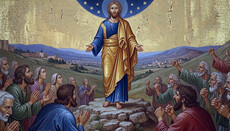
Christ brings people not a battle sword but a kitchen knife. This difference changes the entire meaning of His words about the division of the family.
In the excavated quarter of Capernaum, Franciscan archaeologists Virgilio Corbo and Stanislao Loffreda spent decades removing soil layer by layer until they reached the roughly hewn basalt of the first century on which the ancient city stood. The houses of that period were built without corridors and without windows facing the street; instead, they opened only onto a shared courtyard. These dwellings also had no doors, only open doorways without door leaves.
Excavations uncovered two such houses standing side by side. They may have belonged to the Apostle Peter and his brother Andrew. The two families lived under a single roof made of crossed wooden poles covered with a layer of mud plaster—the very kind of roof through which a hole was once opened to lower the paralyzed man before Christ (Mark 2:1–12). Underfoot was an uneven basalt floor, full of cracks into which a coin could easily roll, recalling Christ's parable of the woman who searched for her precious coin by lamplight (Luke 15:8).
The inhabitants of this quarter lived in full view of their relatives. They ground grain at a common millstone and baked bread in a shared oven. If one member of such a household suddenly became a Christian while the rest remained faithful to the pagan cult, there was virtually nowhere to hide from the family's collective anger and condemnation.
This is where the Lord's words come to mind: "I did not come to bring peace, but a sword" (Matthew 10:34). They are often invoked to justify breaking off relations with an unbelieving father or an antagonistic sister. Yet in the biblical original, the passage is speaking about something quite different.
Goliath's Sword and the Butcher's Knife
In the Greek text, the word for sword is "machaira." It is important to understand that this word did not denote a heavy double-edged blade for combat on the battlefield – the Greeks had a different word for that: "rhomphaia," a long sword-sabre.
A machaira is a short knife, an everyday blade used to cut up a carcass at the market or to perform a sacrifice. In meaning, this word is closer to our kitchen knife or a surgeon's scalpel than to a warrior's weapon.
The difference between the two blades is evident in a biblical episode. Josephus Flavius, describing the young David's victory over Goliath, notes that David cut off the Philistine's head with his own rhomphaia, since David had no machaira of his own. Notably, two different words are used in a single phrase to denote two different blades.
The Apostle Paul, in his Epistle to the Hebrews, chooses the same word as the Evangelist Matthew: "For the word of God is living and powerful, and sharper than any two-edged sword, piercing even to the division of soul and spirit, and of joints and marrow, and is a discerner of the thoughts and intents of the heart" (Heb. 4:12). Here he refers to the same machaira.
Holy Scripture is likened not to a warrior cutting down an enemy with a sword, but rather to a surgeon making a precise incision with a scalpel through living tissue.
In The City of God, St. Augustine of Hippo explicitly connects these two passages of Scripture. In his view, the Word of God is called a double-edged sword because the two Testaments are equally sharp. Together, the Old and New Testaments form a single blade that cuts straight through families to the quick.
What does God's knife actually cut?
Commenting on the same words from the Gospel of Matthew, St. Theophylact of Bulgaria writes that the sword signifies the word of faith, which cuts us off from the mindset of our household and relatives whenever they hinder us in the pursuit of godliness. The separation, then, is not from our relatives themselves, but from their influence over us when that influence leads us away from the faith.
If machaira refers not to a battle sword but to a surgeon's knife, then using it to strike our neighbor is a misuse of an essential instrument. This knife is meant to be directed not outward but inward, to the place in our hearts where attachment to our family's approval has taken root at the expense of our devotion to God.
To cut off this attachment means remaining a Christian in a place where you are not understood and are rejected. But to drive a brother or mother out of the house, or to strike someone symbolically with the Word of God for holding different views, is to take into one's hands a completely different blade from the one Christ gave us. In doing so, we are striking our neighbor with the very sword of Peter, which the Lord commanded him to put back into its sheath in the Garden of Gethsemane, for those who take up the sword will perish by the sword.
Life in a house without a door
It is easy to reason about spiritual matters while living in a modern apartment, where a quarrel with relatives can be ended with a single click of a door lock or by blocking someone in a chat. The resident of a Capernaum insula had no such option.
After becoming a Christian, a person who had separated from his relatives would still continue living with them in the same courtyard. Every morning he would go on grinding grain and baking bread shoulder to shoulder with those who regarded him as a traitor to the faith of his fathers.
In this case, separation did not mean moving away, but consisted in the courage to uphold one's faith while daily remaining among hostile family members, from whom one could not even shut oneself off with a door because there were no doors between the houses at all.
Christ’s words about the sword are not a blessing for breaking with an unbelieving family, but a difficult call to remain with them as a confessor of the faith. The knife of the Gospel does not cut into people’s bodies, but into the soul of the one who surgically cuts away whatever prevents him from being faithful to God.
If a sword has ended up in our hand, before using it to wound someone, we should check whether it is truly the right blade. Whoever turns the knife against their neighbor is already holding not a gift from God, but an enemy’s rhomphaia. And Christ’s machaira cuts only the conscience of the one who holds it.