
The bully who learned to love his enemies
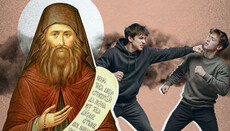
St. Silouan the Athonite bent iron, drank vodka, and nearly killed a man with a single punch. In the end – he became a saint.
A blow rang out – and a man was sent flying, collapsing into the dust of the road. Passersby rushed over and splashed cold water on him. More than half an hour passed before he could get to his feet, and even then he had to be led home, barely alive. He spent two months recovering. It was a miracle that he survived at all.
The man who struck him was a village youth named Semyon Antonov.
For weeks afterward, the beaten cobbler’s brothers lurked in the dark corners of the village with clubs and knives, determined to take revenge. What saved Semyon from certain death was what he would later call the providence of God. What saved him from the stigma of becoming a murderer was the simple fact that the cobbler lived.
Today the Church knows that young man as St. Silouan the Athonite – the very saint who would later write some of the most moving words ever spoken about loving one’s enemies.
Between that roadside brawl and those words lay an entire lifetime.
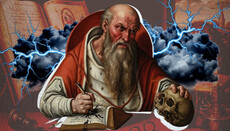
A giant without restraint
Semyon was nothing like the pale, delicate youths that later iconography often paints as saints. He was a peasant giant of almost unbelievable strength.
Barehanded, without so much as a rag, he could lift a boiling cast-iron pot from a blazing stove and carry it to a table where workers were eating. A single punch could split a thick plank. He could lift loads that would knock three men off their feet.
When the time came for military service, he was naturally selected for the Imperial Guard’s sapper battalion in St. Petersburg, where only the tallest and strongest men were accepted.
His temperament matched his physical power.
He worked like three men and drank without restraint – finishing a quarter bottle of vodka in an evening and standing up as if nothing had happened. At village festivities he was quick to fight. The incident with the cobbler revealed his true nature: an immense, fiery, untamed force of masculinity that had nowhere to go except into breaking and destroying whatever stood before it.
The snake in the dream
A man like that could not be changed by fear or shame. He simply feared no one.
The turning point came in another way – through something miraculous.
One day, after a bout of revelry, Semyon dozed off. Half-asleep, he saw a snake crawling into his mouth. He recoiled in disgust and sprang awake.
At that very moment he heard a quiet female voice of indescribable beauty:
“You swallowed a snake in your dream, and it disgusts you. That is how unpleasant it is for Me to see what you are doing.”
He saw no one nearby. Yet later he never doubted that it was the Most Holy Theotokos herself speaking to him.
The giant who could break boards with his fists was brought low by a single comparison: your life is like that vile creature in your mouth.
From that day began the long labor of changing himself – a task far more difficult than starting another fight.
The mill and the sleepless nights
In 1892 Semyon stepped off a boat on Mount Athos and entered the Russian Monastery of St. Panteleimon as a novice.
His first obedience was at the mill, where he carried sacks of flour from dawn until dusk in stifling heat. For the first time, the strength that had once knocked men down was being used not for destruction but for creation.
At the same time, he almost stopped sleeping.
For years he would doze only briefly, sitting upright for a few minutes at a time. The rest of the night was spent in prayer.
One day, exhausted by months of spiritual struggle and pushed to the limits of human endurance, he saw the living Christ in the monastery church.
A fire passed through his entire being with such intensity that, as he later said, had the vision lasted even a moment longer, he would have died.
The inner engine that once drove his fist into another man’s chest had now been redirected toward the spiritual life with the same overwhelming force.
The highest standard
The man who had nearly killed a neighbor over a dance tune eventually reached a spiritual measure beyond which there seems to be nothing higher on earth.
He tested faith by one criterion: the ability to love one’s enemies.
Not merely to tolerate them through clenched teeth. Not merely to forgive them by an act of will. But to love and pity them so deeply that one’s heart aches more for the persecutor than for oneself.
Where this love is absent, the elder taught, the grace of the Holy Spirit is absent as well, no matter how much a person fasts or prays.
“To pray for people is to shed blood,” he once said.
And he shed it.
Night after night he stood in prayer and wept – for the whole world, for every human being, for all the descendants of fallen Adam, including young hotheads with knives in their hands, just as he himself had once been.
The former brawler, the terror of village festivals, set himself a spiritual standard that no strongman could ever achieve. His goal was no longer to knock an opponent down, but to lift him up and carry him on his shoulders through prayer, as one carries a wounded man from a battlefield.
Those who today are torn apart by anger and rage and have convinced themselves that the road to God is closed to them should remember this saintly giant.
Not a gentle angel, but a powerful Tambov peasant with fists like hammers who learned to love people after climbing out of the abyss of sin.
God did not take away his strength – He simply turned it in the right direction.
And the man whom the cobbler’s brothers once hunted through dark alleys in search of revenge spent the next half-century of his life weeping for those who suffered.