
The Myrrh-Bearing Women: the faith of the heart that triumphed over reason
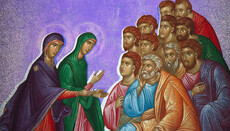
Why did the reason of the apostles collapse before Golgotha, while the feminine nature revealed courage? The lesson of the Myrrh-Bearing Women – about encountering God and the abandoned Shroud.
In the turning cycle of the liturgical year, we pass from the intellectual feat of the Apostle Thomas – who sought tangible proof of dogma – to the quiet and radiant ministry of the holy Myrrh-Bearing Women. This transition marks a profound dilemma of the human spirit: the rupture between rational knowledge and the contemplation of the heart.
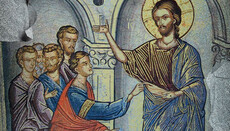
Intellect of the apostles and the intuition of love
The Gospel narrative is strikingly sparing in recording the words spoken by the women. While the apostles – the future pillars of the Church – engaged in intense debates, attempting to fit Christ’s universal teaching into the narrow frames of their national and political expectations, the Myrrh-Bearers remained silent. When the Savior foretold His death, the minds of the disciples were occupied with hierarchy: “there arose a dispute among them, which of them should be accounted the greatest” (Lk. 22:24). When He revealed the mystery of Golgotha, they dreamed of thrones: “grant unto us that we may sit, one on Thy right hand, and the other on Thy left, in Thy glory” (Mk. 10:37).
The apostles tried to “tame” the Truth – to adapt it to the human logic of success. The women simply co-lived the event of Christ.
They did not seek meanings – they sought the Savior Himself, helping Him bear His earthly Cross not through philosophical treatises, but through daily, sacrificial service.
At the hour of the catastrophe of Golgotha, “intellectual faith,” built upon logical constructions and earthly hopes, collapsed. The apostles, paralyzed by fear and disillusionment, shut themselves behind locked doors. Their reason, having correctly calculated the risks, whispered: “It is finished.” But the faith of the Myrrh-Bearing Women was of another order. It was a faith “against all odds.” The spiritual intuition of the heart ran ahead of logical reasoning. While reason spoke of the immovable stone and the inevitable danger from the guards, love drove them into the pre-dawn darkness.
In the experience of the heart, a depth is revealed that reason cannot reach. Love knows no fear, because it does not calculate the probability of success – it simply cannot act otherwise.
There is a subtle boundary in the knowledge of God. We know that “God is love” (1 Jn. 4:8), and love by its very nature belongs to the realm of the personal, the existential. This is why, in our churches, women have traditionally been more numerous – their nature more responsive to the living presence of God, unburdened by excessive theorizing. Yet this does not diminish the significance of the Logos. The Church of Christ stands upon the Incarnate Word, who assumed male nature. But it must be remembered: the Incarnation became possible only because a Woman appeared in the world – the Most Holy Virgin, whose sanctity and humble purity surpassed all human understanding.
Without the feminine readiness to receive God with the heart, the masculine proclamation of Truth would have remained barren.
The abandoned Shroud: faith in Presence
The most piercing moment of their feat is their departure from the empty tomb. Having heard the message that Christ is risen and “goeth before you into Galilee” (Mt. 28:7), the Myrrh-Bearers hasten away. In this sacred urgency, they leave behind the Shroud. From the standpoint of modern “religious routine,” this seems strange. One might imagine turning this cloth into an immediate object of veneration – adorning it with flowers, forming lines of pilgrims, transforming the cave into a museum of memory.
But the Myrrh-Bearers forgot the thing because the Person had been restored to them. Love seeks the Living One, not His traces. Faith is directed toward Presence, not toward remembrance.
If a wife, instead of communing with her living husband, prefers to kiss his old photographs, there is something pathological in such love. So too in the Church: if the veneration of holy things – icons, relics, festive offerings – obscures the Face of the Risen Lord, our piety becomes a refined idolatry.
We are called not to archive antiquities, but to enter into a living dialogue with God and His holy friends.
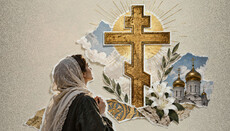
The Risen Christ appeared first to women not by accident. It was a reward for a fidelity greater than wisdom. The same fidelity was shown by the “white headscarves” of the twentieth century – simple women on whose fragile shoulders the Orthodox Church passed through the furnace of persecution. While ideologues argued about dialectics, they simply prayed, baptized their grandchildren, and remained faithful to Christ in the face of threats and mockery.
Today, when the spirit of division again rises against holy things and against the Mother Church, it is Orthodox women who stand in the vanguard of prayerful witness. Walking miles in крестные ходы, defending churches from desecration, they reveal to the world that same “courage of the heart” that once led their foremothers to the empty Tomb.
As we celebrate the memory of the Myrrh-Bearing Women, we are called to remember what matters most: our Paschal joy must be rooted in a living encounter with the Person of the Savior, not in gastronomic relief or the aesthetics of ritual.
The law of spiritual life: strength in weakness
The Myrrh-Bearers teach us a fundamental lesson of Christian ontology: God is not in things, but in communion. The Shroud is a precious witness to the Resurrection, yet it is only the shadow of the One who passed through death. In our spiritual life, there is always the temptation to “remain in the cave” – to become enclosed within outward beauty, ritual precision, or the collecting of sacred objects.
We are accustomed to identifying courage with physical strength or iron will. Yet the Gospel overturns this hierarchy.
The apostles, possessing masculine strength and rational plans, were paralyzed by fear. The women, regarded in that age as “the weaker vessels,” revealed the firmness of adamant.
Here we encounter the law of spiritual life: “My strength is made perfect in weakness” (2 Cor. 12:9). The courage of the Myrrh-Bearers is not the absence of fear, but the superabundance of love that renders fear irrelevant. When the mind says “it is dangerous,” and the heart says “there is my Lord,” the heart prevails. It is this orientation that defines holiness.
And yet, while we exalt the faith of the heart, the Church warns us against the excess of mere emotionalism. The Myrrh-Bearers did not simply “feel” – they acted in accordance with the commandment. Their love was active, not ecstatic.
In their conduct is revealed the true role of woman in the Church. It lies not in “teaching” or “administration,” but in being the guardian of life. The Myrrh-Bearers were the first to bring the news of the Resurrection to the apostles themselves. This is a striking paradox: those who, by the law of that time, were not considered valid witnesses in court became the chief witnesses before eternity.
The forgotten Shroud is a symbol that in the Kingdom of God we shall need no intermediaries. In these days after Pascha, we are called to examine our bearings: have “kulich and eggs” – these good symbols of the feast – become ends in themselves?
For our life in the Church is an unceasing journey from the shadow of the empty cave to the light of Galilee, where the Savior awaits each of us personally.
May the example of the holy Myrrh-Bearers teach us that divine simplicity which knows how to leave the secondary for the sake of the Essential. May our reason be humble enough not to hinder the heart as it runs to meet the Risen Christ, and may our love be bold enough not to fear stones, guards, or the judgments of this world.