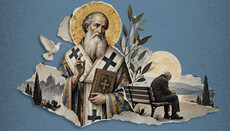

The architecture of silence: when all flesh falls still
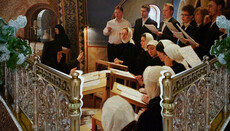
The Church calls us into a silence in which eternity is born. On Holy Saturday, silence becomes the presence of God, transforming a person from within.
In the modern world, silence is almost always perceived as an annoying malfunction – a dropped connection or dead air that must immediately be filled with something. We live inside a dense cocoon of sound: the hum of traffic, messenger notifications, background music in cafés, an endless stream of news. This “white noise” has become our natural habitat, a reliable shield against a frightening emptiness. We avoid even the slightest pause in conversation or silence in a room, turning on a phone or television. It seems that if the sound stops, the world will fall apart.
Sometimes a useful exercise is simply to sit alone, without gadgets or background noise. Not to meditate or practice the now-fashionable “mindfulness,” but simply to be silent. Most likely, after a few minutes, a dull тревога will begin to rise within. Silence presses in – it forces us to remain alone with our own thoughts, fears, and inner disorder, which we so successfully drown out with busyness. Silence demands from us the courage to be ourselves, and we find we are not ready for that.
It is precisely at this point of our deepest discomfort that the Church’s choir strikes on Holy Saturday.
The service proceeds in its usual order, and at a certain moment the familiar liturgical rhythm is disrupted. Where on most days of the year the solemn and majestic Cherubic Hymn is sung – preparing us for the offering of the Bloodless Sacrifice – the choir takes up a different tone. Once a year, the Cherubic Hymn gives way to an ancient text, and with it the familiar call to “lay aside all earthly cares” seems to be removed from the service. On this single Saturday of the year, the Church invites us to set aside not only our cares, but every action, every word, and even every movement of the soul.
The choir sings slowly, stretching each syllable into a tempo that leaves no room either for distraction or for filling the pauses with our own thoughts. It is music that builds around us an architecture of stillness.
A call to stillness
The ancient Greek word “sigisato,” with which this hymn begins, is an authoritative command for the immediate cessation of all activity – for absolute silence. The command is addressed to our mortal flesh, to the biological layer of our being. To that very “mortal substance” which fears the most, bustles the most, and seeks an escape from every difficult situation.
After the body, our capacity to calculate, to weigh options, to construct logical chains, and endlessly to explain the world to ourselves must also come to a halt. The generator of our inner monologue – which never falls silent even for a moment – must be stopped. We are accustomed to thinking that prayer means speaking: asking, thanking, explaining our situation to God in detail, as if He needed it. And suddenly, all of this is taken away from us.
The text of the hymn itself explains why this silence is required. In those moments, the space of the храм is filled with a Presence before which all words grow pale. “The King of kings and Lord of lords comes… and the ranks of angels go before Him, with every principality and power.”
A silence hangs in the air like a drawn bowstring. It is the utmost tension before an event that can neither be stopped nor hastened.
White vestments above the abyss
While the choir sustains its chant, a transformation takes place in the altar – one not everyone sees. The clergy change their vestments. Throughout Great Lent and the sorrowful days of Holy Week, the priests have served in black or dark purple. But at this moment, under the sound of the command to silence, the vestments become white.
This change is made deliberately by the Church. Holy Saturday is the day when God rests in the Tomb, having completed the work of our salvation.
This rest is called the Great Sabbath: the Creator rests from His labors, as at the beginning of time after the creation of the world. Only now these labors are the re-creation of man and the healing of the very nature of life.
Any intervention on our part in this process – any attempt to “help” God with our words or activity – is unnecessary. He does not need our activity; He needs our silence. He descends into the very depths of human death, to a place where no living person can follow. We can only wait at the threshold, not interfering with the Mystery as it is accomplished.
This is what may be called the art of liturgical waiting – a reverent standing before that which surpasses human understanding. When the Creator is silent in the Tomb, creation must fall silent with Him, lest it miss the moment when the first light begins to glimmer out of the darkness.
The origin of the hymn
This hymn was born in the Jerusalem liturgy of the Apostle James in the 4th–5th centuries. It arose in immediate topographical proximity to the actual Golgotha and the actual Tomb of the Lord. People felt that in the place where God died and was buried, any sermon or prayerful complaint sounded false.
A text was needed that would legitimize human silence before the sacred. Thus appeared the call: “Let all mortal flesh keep silence.”
Later, it entered the Liturgy of Basil the Great and became fixed to a single day of the year. It is the law of Sabbath rest, transferred from the realm of religion into the realm of personal spiritual experience.
We live in a culture where a pause in conversation is perceived as awkwardness, and silence as a symptom of loneliness. We have forgotten how to hear what our own soul is saying, because we long ago drowned it out with external noise. “Let all mortal flesh keep silence” – these are the only few minutes in the entire year when the Church, firmly yet gently, takes away from us the possibility of our habitual escape from ourselves. In those moments, one cannot plan, cannot analyze mistakes, cannot even repent in the usual sense of the word. One can only stand and absorb the silence, which becomes almost tangible.
What follows silence
When all words are exhausted, and the inner generator of thoughts is finally stilled, something very important begins to happen within a person. It happens quietly and almost imperceptibly, like the unfolding of morning light in a room.
In this prayerful silence, we suddenly understand that God acts not when we loudly ask Him, but when we finally stop interfering with Him by our noise. Holy Saturday teaches us that there are moments in life when the only right action is the absence of any action.
When we leave the church after this service, the world around us seems unchanged – the cars make the same noise, people hurry along as before, shop windows still glow. But within us remains that cold, pure echo of Saturday’s silence.
It turns out that silence is not the absence of sound. Silence is the presence of the One who needs no words to hear us.
And perhaps the most precious thing we can carry from this day into our ordinary lives is the ability, at least now and then, to press the “pause” button. To resist the urge to cram every unoccupied second with noise and motion. To allow God to work within us without our constant instructions, explanations, and restless interference. For all that is truly great is born in silence – from the hidden rising of the grass to the miracle of the Lord’s Resurrection, which likewise came to pass unseen by human eyes.