
Patriarch Ilia: a righteous man who lived among us
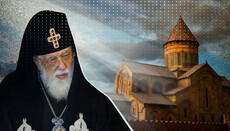
Georgian Patriarch Ilia II has departed to the Lord. A man who was considered a saint during his lifetime and who became the spiritual father of his people.
On March 17, 2026, Catholicos-Patriarch Ilia II of All Georgia reposed. Saint John of Kronstadt titled his diaries: "My Life in Christ." Patriarch Ilia had such a life in Christ for 93 years. Of these, he carried the obedience of Primate of the Georgian Orthodox Church for almost half a century – longer than anyone else in history.
Life in Christ is not a straight ascending line of spiritual growth. It is primarily trials through which God leads us. Situations where we must choose how to act: according to God's commandments or according to the rules of this world, which lies in evil. And when a person holds such a high position, not only his own fate depends on his choice, but the fates of millions of people. Let’s find out what Patriarch Ilya’s life was like and what choices he made during the many trials that befell him.
Childhood and school of faith
The future Patriarch, Irakli Georgievich Gudushauri-Shiolashvili in the world, was not born into an ordinary family. The history of his lineage spans 15 centuries and was first mentioned during the time of King Vakhtang Gorgasali of Georgia (5th century). The future primate was born on January 4, 1933, in Vladikavkaz. His family was well known to the then Catholicos-Patriarch Callistrate (Tsintsadze) of All Georgia. The infant's baptism was performed by Archimandrite Tarasios (Kandelaki), and his godmother was nun Zoila (Dvalishvili), later a renowned Georgian abbess. That is, from birth, the future Patriarch Ilia was in the midst of the deeply believing Georgian national elite. According to his recollections, every evening his father would place the children before the icons, read prayers with them, make one of them recite the 90th Psalm, then sprinkle them with holy water and send them to sleep. He himself would continue praying.
But it was not this idyllic picture that defined the atmosphere in which Irakli was raised. Let us not forget that these were the 1930s – the peak of repression in the USSR. It was during this period that the largest number of clergy and lay faithful were executed. At that time, Irakliy’s family provided shelter in their home to persecuted priests, risking their own lives and the future of their children. Formal piety alone could not accomplish this; such acts required sincere and self-sacrificial faith.
Service instead of career
When Irakli graduated from secondary school No. 22 in Dzaudzhikau in 1952, persecution of the Church had somewhat weakened. In the midst of the war, Stalin allowed the opening of some monasteries and theological schools, and the printing of spiritual literature in small quantities. Therefore, Irakli's enrollment in Moscow Theological Seminary and then the Academy did not yet present the challenge that would arise later.
But he completed his theological education already in the midst of Khrushchev's persecutions. These persecutions were less cruel but more widespread. Government agencies, enterprise management and staff, trade unions, the Komsomol, public organizations, etc. created around believers an atmosphere of rejection, cultural isolation, in which they felt like second-class citizens, outcasts of society. At this time, Khrushchev promised to "show the last priest on television" in a few years.
Under these circumstances, Irakliy had the opportunity to secure a relatively calm future in Moscow. All the conditions for this were in place. In 1957, he took monastic vows and was ordained a deacon. In 1959, Patriarch Alexy I ordained him as a hieromonk and immediately awarded him a golden cross – a sign of a promising ecclesiastical career. In 1960, Hieromonk Ilia graduated from the Moscow Theological Academy and, as one of the top graduates, received an invitation to stay on to teach and engage in scholarly work.
But Ilia chose differently. He went to Tbilisi to Catholicos-Patriarch Ephrem II, who advised him to act "as his heart suggests." And his heart suggested returning to his homeland and serving where there were almost no priests, where authorities had launched anti-religious campaign, and the risk of ending up if not in prison, then in a psychiatric hospital, was significantly higher.
As a result, in 1960, Ilia became a cleric of Saint Nicholas Cathedral in Batumi, Adjara, where a significant part of the population professes Islam. Later, Patriarch Ilia would say that it was there he truly understood the meaning of the word "flock."
Steadfastness that came at a cost
On August 25, 1963, Ilia was consecrated Bishop of Shemokmed and appointed Vicar to Catholicos-Patriarch Ephrem II. Already in autumn 1964, despite government resistance, Catholicos-Patriarch Ephrem II and the young bishop succeeded in opening, in ancient Mtskheta, the only theological educational institution in Georgia at the time – the Pastoral-Theological Courses named after Bishop Gavriil (Kikodze). A year later, the courses were transformed into the Mtskheta Theological Seminary, and Ilia remained its rector until May 26, 1972.
For us today, this is a dry fact of church history. But then it was something more. In Soviet Georgia, the Church was allowed to exist only within narrow, almost museum-like confines: old people, a few temples, minimal clergy, no future. And here – a seminary! The future of the Church!
On September 1, 1967, Bishop Ilia was transferred to the Sukhumi-Abkhazian See. The flock was multinational, and the future Patriarch served not only in Georgian, but also in Church Slavonic, Abkhazian and Greek languages. He ensured that the Church was not an instrument of national pride but a home where all were welcome.
From 1964 to 1977, Ilia headed the Department of External Church Relations of the Georgian Orthodox Church. This was a difficult obedience. The Georgian Church is one of the most ancient: according to tradition, it was founded by the Apostle Andrew the First-Called. But when Georgia became part of the Russian Empire, its autocephaly was abolished. After the 1917 Revolution, Georgian hierarchs proclaimed its restoration. The Russian Church recognized this autocephaly only in 1943, but other Local Churches still viewed the Georgian Church as autonomous within the ROC.
So, in November 1964, at the Third Pan-Orthodox Conference on the island of Rhodes, Bishop Ilia raised before the Constantinople Patriarchate the question of international recognition of the Georgian Church's autocephaly. Failing to gain understanding, he left the meeting in protest. This move had very concrete consequences. When Catholicos-Patriarch Ephrem II passed away on April 7, 1972, the unanimous opinion of the Georgian faithful and clergy was that Ilia should ascend to the Patriarchal Throne. However, his candidacy was rejected by V. A. Kuroyedov, chairman of the Council for Religious Affairs under the Council of Ministers of the USSR, who directly cited the “disruption” of the Rhodes meeting in 1964.
Patriarch who did not dissolve the Church in the "spirit of the times"
On December 25, 1977, Ilia II nevertheless became patriarch. At this time, the Georgian Church was experiencing far from its best times: few priests, almost no monasteries, churches closed or converted into warehouses, clubs, workshops and so on. Despite government opposition, Patriarch Ilia made every effort to restore church life. In just the first two years of his patriarchy, 34 clergy were ordained. In 1985, he secured permission to publish the Bible in modern Georgian. In 1988, he opened the Tbilisi Theological Academy.
Today the Georgian Church has 46 eparchies, about 2,000 active churches and monasteries, and approximately 3,000 clergy. But Ilia's patriarchy was not only about Church revival but also about serious trials. By the late 1980s, the temptations of Soviet power had ended, but the trials of the “spirit of the times” began. Here too, the Primate demonstrated steadfastness.
In May 1997, the Holy Synod of the Georgian Church decided to withdraw from the World Council of Churches and from the Conference of European Churches. In his letter to the WCC dated May 22, 1997, Patriarch Ilia II wrote that the reasons for this were attempts to give the WCC an "ecclesiological character" and rejection of those forms of ecumenism that had become dominant.
Patriarch Ilia maintained the same line in 2016, when the Georgian Church refused to participate in the Council of Crete, which was supposed to affirm the dominance of the Constantinople Patriarchate in Orthodoxy. Among the reasons that prompted this decision were dogmatic, canonical and terminological flaws in the documents that were proposed for approval.
But firmness in church matters was combined in Patriarch Ilia with prudence and peacemaking in political storms. On April 9, 1989, when a mass rally was taking place on Rustaveli Avenue in Tbilisi with calls for Georgia to leave the USSR, Patriarch Ilia came out to the people at three in the morning and began persuading them to leave the square and go with him to pray at the Kashveti Church. They did not listen to him, and 19 people died in clashes with Soviet troops.
Then, when civil war broke out in Georgia in December 1991 – January 1992, Patriarch Ilia attempted to reconcile the warring parties by organizing negotiations in the Patriarchate. In August 2008, during the Georgia-Russia war, the Primate participated in negotiations for the release of prisoners of war and was able to evacuate the bodies of the dead from the conflict zone.
This is very telling: in the most dramatic moments of Georgian history, Patriarch Ilia did not raise political stakes, did not take sides, but acted as a peacemaker, helping the victims of conflicts, and doing everything possible to reduce grief and suffering.
The Georgian Church and the Ukrainian question
Speaking of Patriarch Ilia's steadfastness in doctrinal and canonical matters, one cannot ignore the Georgian Church's position regarding the uncanonical creation of the OCU. We would, of course, like Patriarch Ilia's stance here to be equally firm, for him to speak as clearly about the inadmissibility of recognizing anathematized schismatics. But, alas... This did not happen.
Both before and after the creation of the OCU in 2018, Ukrainian politicians contacted Georgian hierarchs regarding recognition of this religious organization and even declared prospects for such recognition. In January 2019, the Georgians said they would decide after familiarizing themselves with the text of the OCU's Tomos, and then postponed this question indefinitely. To this day, the Georgian Church has not recognized the OCU, but has also not declared the impossibility of such recognition.
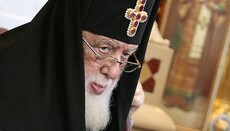
The only thing that comforts us in this regard is Patriarch Ilia's letter to Constantinople Patriarch Bartholomew, written in March 2023, in defense of the UOC.
Godfather
One of Patriarch Ilia's strongest and most vibrant initiatives was the mass baptism of children. In 2008, he announced that he would become godfather to every third child in a family. The first such baptism took place on January 19, 2008, at the Sameba Cathedral. By the end of 2009, he had 3,700 godchildren, and by July 2025 – almost 50,000.
Did this affect Georgia's demographics? Yes. In 2025, the serious academic resource, The Journal of Population Economics, assessed the birth rate growth among married Georgian Orthodox women at 42%, and for third and subsequent births – approximately 100%. Overall, the country’s total fertility rate increased by approximately 17%. The journal cautiously linked this to Patriarch Ilia’s initiative.
But it's not about the numbers, of course. The Patriarch literally became family to tens of thousands of Georgian families, and Georgians responded with such love and gratitude that cannot be gained by position or through television.
Today all of Georgia, without any exaggeration, is mourning its Patriarch.
***
We would like to conclude this publication not with pompous praise for Patriarch Ilia, but with the words of the Apostle Paul: "Remember your leaders, who spoke the word of God to you. Consider the outcome of their way of life and imitate their faith" (Heb. 13:7).