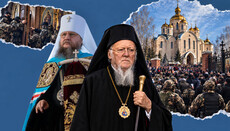

Why are Orthodox hierarchs getting us used to “archbishopesses”?
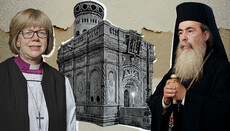
Patriarch Theophilos of Jerusalem receives an Anglican archbishopess. At the Phanar, Orthodox hierarchs pray alongside lesbian “bishops.” This is neither courtesy nor diplomacy. It is how the Overton window opens.
On June 24, 2026, Patriarch Theophilos III of Jerusalem received Sarah Mullally, the Anglican Archbishop of Canterbury. She was accompanied by Anglican Archbishop in Jerusalem Hosam Naoum and others.
At first glance, it might seem like an ordinary diplomatic meeting with a religious leader visiting the Holy City. Such meetings are not unusual. In autumn 2025, for instance, Patriarch Theophilos guided U.S. Vice President J.D. Vance through the holy sites of Jerusalem.
But this case is different.
Sarah Mullally is not a politician or a public figure. She is the first “archbishopess” to head the Church of England. An official meeting with her by the Patriarch of Jerusalem – and especially common prayer – is not simply a gesture of courtesy. It is a silent legitimization of women’s “ordination,” a step toward its recognition across the Christian world.
This is how the Overton window opens.
The official position of the Orthodox Churches
The issue of women’s “ordination” arose in the Anglican Church as early as 1976. In 1978, a special meeting of the Anglican–Orthodox Doctrinal Commission was held in Athens. The commission included representatives of the Churches of Constantinople, Jerusalem, Alexandria, Antioch, Russia, Romania, Bulgaria, Greece, Cyprus, Poland, and Finland – in other words, almost the whole Orthodox world.
In the final document, the Orthodox members unanimously condemned the ordination of women and called it an "innovation" which has no foundation in Holy Tradition, arguing that "it is important, therefore, to distinguish between innovations and the creative continuity of Tradition."
What is especially important is that the Orthodox participants in the Athens statement "cannot regard the Anglican proposals to ordain women as a purely internal matter, in which the Orthodox are not concerned." They wrote directly: “ We Orthodox see the ordination of women, not as part of this creative continuity, but as a violation of the apostolic faith and order of the Church.”
In 2006, at a meeting of the Anglican–Orthodox Commission in Cyprus, the Orthodox participants again expressed categorical disagreement with the decision of Anglican churches to ordain women.
Many Local Churches described women’s ordination as an obstacle to dialogue with Anglicans. In 2008, after the General Synod of the Church of England approved the introduction of women bishops, the Russian Orthodox Church stated that the decision “significantly complicates dialogue between Orthodox Christians and Anglicans, further distances Anglicanism from the Orthodox Church, and contributes to the further division of the Christian world as a whole.”
But times change.
What happened in Jerusalem
This was not merely a diplomatic reception – it was common prayer. Sarah Mullally herself says so.
On the official website of the Archbishop of Canterbury, she thanked Patriarch Theophilos for receiving her and said that “to pray together in that holy place, at the heart of the Christian story, has been a profound gift.”
As is well known, Orthodox canon law has always treated common prayer as a serious ecclesiological act. Numerous canons strictly forbid not only liturgical concelebration but even simple prayer with those outside Church communion. Apostolic Canon 10 states: "If any one shall pray, even in a private house, with an excommunicated person, let him also be excommunicated.”
Here, however, we see not simply prayer with someone outside the Church, but prayer with a person who undermines one of the basic principles of the priesthood and promotes the LGBT agenda even at the cost of a split within her own church.
Sarah Mullally, who advocates the blessing of gay couples, became the first female Archbishop of Canterbury in the history of the Church of England and the spiritual leader of some 85 million believers worldwide. Yet her appointment provoked a major crisis within Anglicanism itself. In October 2025, the Anglicans of Nigeria broke away from Mullally. In March 2026, 347 bishops and 121 leaders from 27 provinces of the Global South formally announced a break with the administrative center in London and created their own Global Anglican Council.
The picture is strange.
Even within Anglicanism – a religious community generally regarded as rather liberal – Mullally is unacceptable to many. Yet an Orthodox Patriarch apparently sees no problem in praying with her in the Holy Land.
Of course, one cannot say that Patriarch Theophilos formally recognized women’s ordination by this act. But it is unquestionably a departure from the apostolic and patristic tradition.
Was necessity the reason?
Why does Patriarch Theophilos need such meetings at all? The Church’s attitude toward women’s ordination, the Anglican split caused by it, and Sarah Mullally’s support for the gay agenda are all well-known facts. The Patriarch of Jerusalem is certainly aware of them.
Perhaps the explanation lies in the present condition of the Jerusalem Church. And that condition is rather bleak.
In August 2025, Jerusalem municipal authorities froze the bank accounts of the Jerusalem Patriarchate over a tax dispute. Patriarchate staff, schools, monasteries, and charitable institutions were left without funds.
The dispute concerns not only the Orthodox. In March 2025, the heads of the Christian Churches of the Holy Land protested attempts to force them to pay taxes, warning that the unbearable financial burden could threaten the very presence of these Churches in the region.
The war in Gaza has made the situation even worse. The Jerusalem Patriarchate is trying to help refugees, which requires major financial resources. The Orthodox Monastery of St. Porphyrios, for example, became a shelter for hundreds of civilians.
The Jerusalem Church needs international support and financial assistance and hopes to receive it from influential Christian structures in the West. Perhaps this explains the warm reception given to the Archbishopess of Canterbury in Jerusalem.
Patriarch Theophilos may be making compromises not for himself, but for the good of the Church. But is the price not too high?
Constantinople opens the Overton window even wider
If Patriarch Theophilos’ action can be explained by the difficult position of the Jerusalem Church, the case of the Patriarchate of Constantinople is somewhat different.
On January 30, 2026, an ecumenical prayer service was held at Holy Trinity Cathedral in New York, which belongs to the Archdiocese of the Patriarchate of Constantinople in the United States. Representatives of various confessions took part, including Lutheran “bishopess” Katrina Foster.
Foster is not simply a “bishopess” – she is also an openly practicing lesbian. Also participating was Episcopal “priestess” Kirsten Guidero, known for promoting LGBT ideology. Representatives of the Patriarchate of Constantinople prayed together with all of them.
Earlier, in 2022, in Istanbul, Patriarch Bartholomew prayed with representatives of other religious organizations “for ecumenical unity.” Among those praying was an unidentified woman wearing an epitrachelion.
And such services are unlikely to stop. On the contrary, given the number of women’s “ordinations” among Anglicans, Lutherans, and Protestants, this trend will only grow. There is little doubt that Constantinople’s hierarchs also justify such contacts by considerations of “the good of the Church.”
The old trap of compromise
The idea of “compromise for the good of the Church” is not new. Today it is justified by the need for financial assistance, international support, dialogue, peace, and so on. It all sounds very noble. It can even look like self-sacrifice.
But Church history testifies to something else: when hierarchs begin doing things contrary to doctrine or Church morality “for the good of the Church,” the result is the opposite.
One example is the Council of Ferrara–Florence in the 15th century. Constantinople was then on the verge of being conquered by the Turks and desperately needed military help from the West. The emperor and a significant part of the hierarchy agreed to union with Rome “for the good of the Church and the empire.” The result: the city received no real help, the Church was pushed to the brink of schism, and in 1453 Constantinople was captured by the Ottoman Turks.
Another example is the 1927 Declaration of Metropolitan Sergius (Stragorodsky) on complete loyalty to the Soviet regime. He was trying to save the Church from total destruction in the furnace of the repressions of the 1920s and 1930s. The result: the persecution only intensified. Thousands of priests, monks, and laypeople were arrested, exiled, and executed. Thousands of churches were destroyed. The Church fell under the complete control of Soviet agencies. The consequences of this policy, later called “Sergianism,” have not been overcome to this day.
Compromise in matters of doctrine and morality has almost always led to tragedy in Church history and undermined the Church’s authority. And the opposite is also true.
The saints chose fidelity
The Church survived not because of those who knew how to make deals with the powerful at any price, but because of steadfast confession of the faith.
St. Basil the Great lived in the fourth century, when the authorities supported Arianism. Orthodox believers were driven out of churches and sent into exile. The local governor Modestus tried to pressure Basil into accepting Arianism. He threatened him and his flock with confiscation of property, torture, and death. Basil could have compromised – many did. But he answered: “Threaten others, if you can; none of this touches us.”
St. Maximus the Confessor lived in the seventh century, when the authorities supported the Monothelite heresy. Church hierarchs one after another agreed to compromise for the sake of “peace.” But Maximus said: “I do not think about the union or division of Romans and Greeks, but about not falling away from the true faith.”
St. Mark of Ephesus refused union with the Catholics. He stood against everyone: the Byzantine emperor, the Roman pope, Church hierarchs, and the political elite of the empire. And it was his position that saved the Church.
Alongside these saints were those who proposed compromise and skillfully explained concessions by “difficult circumstances” and “the good of the Church.” But the truth of God was on the side of the confessors. History proved them right.
Should an abbot compromise “for the sake of the brotherhood”?
Of course, women’s ordination is far from the only challenge facing the Church today. There is an even sharper example now – the legalization of the OCU.
In the Local Churches, there are well-known hierarchs and clergy who once supported the canonical UOC and then turned around completely. We will not analyze every such reversal – two examples are enough: Patriarch Theodore of Alexandria and Metropolitan Isaiah of Tamassos of the Church of Cyprus. Both visited Ukraine more than once, both warmly supported the canonical UOC and Metropolitan Onuphry personally. And then they “forgot” it all.
It is especially painful when Mount Athos appears in this row – the stronghold of monasticism, a place to which people have come for centuries in search of undamaged faith.
Let us consider the arguments of two abbots: Elder Ephraim of Vatopedi and Archimandrite Elisseos of Simonopetra.
Archimandrite Ephraim repeatedly spoke in support of the canonical UOC and urged Ukrainians to remain faithful to Metropolitan Onuphry. But, as we remember, in 2019 he came to Kyiv for the enthronement of Serhiy Dumenko. True, he did not attend the ceremony itself: he suddenly fell ill and immediately left Ukraine. Later, commenting on the OCU issue, the abbot of Vatopedi said that Athonites could not speak on the subject because the Holy Mountain is under the jurisdiction of the Patriarchate of Constantinople, and therefore all questions about Dumenko should be addressed there.
The rhetoric of the abbot of Simonopetra is even more astonishing.
According to information available to the UOJ, Archimandrite Elisseos told the brethren that if he refused to recognize the OCU, he would be forced to leave the monastery and the Patriarchate of Constantinople would appoint another, more “compliant” abbot. After such an admission, the monks supposedly “would not let him go,” because he was too dear to them.
But is the purpose of a monk’s life to remain head of a monastery at any cost?
Church history offers countless examples of holy abbots who not only did not cling to their position, but willingly sought to leave it in order to devote themselves fully to prayer.
St. Anthony the Great led a monastic settlement, but burdened by crowds, he withdrew far to the east, to Mount Colzim, where he spent the rest of his life near a spring and a few palm trees.
St. Sabbas the Sanctified, founder of the famous lavra near Jerusalem, would leave for the desert every Great Lent for solitary prayer, returning to the brethren only for the feast.
St. Anthony of the Caves, when brethren gathered around him, would again go off to dig a new cave for himself in search of solitude, entrusting the community to appointed abbots.
St. Theodosius of the Caves, even as abbot, would shut himself in a cave each Great Lent for solitary prayer, returning to the brethren only on Lazarus Saturday.
St. Sergius of Radonezh, while abbot of the Trinity Monastery, secretly left the monastery after a conflict with his brother Stephen in order to avoid discord.
St. Cyril of Belozersk was archimandrite of Moscow’s Simonov Monastery, but he was burdened by honor and sought solitude. Having laid down the abbacy, he left Moscow with the monk Ferapont for the north, to Lake Belo, where he founded the Kirillo-Belozersky Monastery. In his case, withdrawal for the sake of prayer became final.
These are only a few examples; in reality, there are many more. Can we imagine any of the saints compromising with conscience simply in order to remain abbot?
One who is ready to sacrifice faith in order to preserve his position is no longer saving the Church – he is saving his place in it. However, that road does not lead where he thinks it does.
Conclusion: The window opens quietly
That which has no place in the Church does not enter through the gates. First comes an ordinary meeting, one of dozens, then shared photographs. Then comes common prayer – and who, after all, will object to prayer for peace?
At every step there are reasonable and “correct” arguments: do not exaggerate; you see the difficult position of the Church; we must be able to talk to everyone. It seems there is nothing to object to. But this is precisely how the Overton window opens – centimeter by centimeter.
The danger is not what is obvious. The Church has always dealt with open enemies and has always outlived them. What is more frightening is something less visible: the readiness of shepherds themselves to yield – naturally, “for the good of the Church.”
History has shown more than once what such concern leads to. The Union of Florence did not save Constantinople – it only brought its end closer. The Declaration of 1927 did not stop the persecution. Each time faith was crossed over “for the good of the Church,” the price proved heavier than the disaster from which people were trying to flee.
The Church was preserved not by those who knew how to make deals, but by those who refused to make them – Basil the Great, Maximus the Confessor, Mark of Ephesus. In their own lifetime they were called stubborn men and destroyers of Church peace. But in the end, they were the ones who proved right.
There is a deeper dimension to all this. Why are we in the Church at all? Is it really in order to arrange Her earthly affairs? No. We are in the Church in order to learn trust in God and to cultivate faith within ourselves.
And what is faith? It is certainly not the ability to bargain or strike deals for the sake of a calmer life for the Church. Christ, the Head of the Church, will care for Her earthly existence. Our task is different: to think about how to be saved and how to strengthen our own faith. This concerns a patriarch, a bishop, and an abbot no less than a layperson. Besides governing the Church, they too must be saved.
As St. Seraphim of Sarov said: “Acquire the Spirit of Peace, and thousands around you will be saved.”
Our faith is strengthened precisely in critical moments – when there is no money, when danger looms, when threats come from every side. It has always been this way. In the church language, this is called temptation. And temptations are not bypassed – they are passed through. They are given so that a person may endure them, hold fast to God, and emerge with stronger faith and a living bond with Him. This is what they are all about.
Attempts to “lay straw” for the Church, or for oneself within the Church, move against faith itself. They are pure human calculation where trust in God is required.
The Psalmist said it long ago: “Put not your trust in princes, in the sons of men, in whom there is no salvation.”
And again: “Unless the Lord builds the house, those who build it labor in vain; unless the Lord watches over the city, the watchman stays awake in vain.”
All of Scripture directs us to the same truth: “Some trust in chariots, and some in horses, but we will call upon the name of the Lord our God.”
Let the mighty of this world place their hope in pulling strings and making agreements. Our path is different, as it should be.