

The revolt of the spirit against the tyranny of the mind
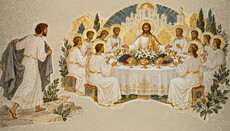
The Gospel parable of the Wedding Feast shatters the naïve illusion of everyday goodness. True salvation requires casting off the worn-out garments of the worldly mind in order to attain the Uncreated Light.
The Gospel parable of the Wedding Feast is, in essence, a fundamental revelation about the very nature of human existence. It shatters the central myth of humanism – the illusion that everyday kindness and simple human decency are enough in themselves to open the door to the Kingdom of Heaven. Ordinary righteousness, turned inward upon itself and preoccupied with arranging a comfortable earthly existence, suffers from existential blindness. It mistakes the temporal for the eternal, the order of this world for humanity’s ultimate destiny.

A person’s habitual existence, however noble the intentions used to justify it, is by its very nature a quiet enslavement to this world. Everything to which the human heart becomes attached turns into an invisible idol that binds the freedom of the person. Even those who find themselves at the “crossroads” – people knocked out of the familiar routines of social life, deprived of comfort and earthly anchors – possess only the possibility of salvation, not a guarantee of it. Renouncing worldly distractions is merely the first, liberating step. It must be followed by an inward putting on of the “wedding garment” – a profound spiritual transformation of the very fabric of the human soul.
The mystery of the hidden wedding garment
The wedding garment is neither an outward adornment nor the sum total of good deeds accumulated over a lifetime. In Eastern Christian thought, it signifies the attainment of an inner Light, a state of spiritual wholeness in which human nature comes to participate in the Higher Principle.
The search for and attainment of this garment belongs to the realm of the most subtle spiritual anthropology.
This knowledge is hidden – not because it is deliberately kept secret, but because it remains inaccessible to the superficial mind. To penetrate these depths requires the abandonment of intellectual pride.
A person cast into this world exists in a state of continual inner trial. The existential lot of the earthly pilgrim is an unending encounter with pain, the fleeting nature of time and decay. To endure the fragility and tragedy of existence without sinking into despair is possible only through a higher vision – when everything that happens is understood as part of a profound Providence. Without this foundation of meaning, sorrow crushes the human self with the relentlessness of a heavy machine, oblivious to the living being in its path.
The army of intrusive thoughts
Yet the central drama of human existence unfolds not in the external world, but within our own consciousness. The tomb in which the spirit sleeps is guarded by countless armies of thoughts, commanded by a general called Reason. The human spirit is an organ of pure contemplation – a deep and quiet consciousness capable of directly apprehending Truth. Reason, by contrast, is the ceaseless inner monologue that, in our ordinary state, becomes an autonomous and restless mechanism generating a chaos of anxieties and thoughts. Our restless mind is the surface layer of the psyche that incessantly “feels its way” around the world, forms patterns of dependency and enslaves us to obsessive ideas.
Any attempt to awaken the sleeping spirit through frantic, hyperactive efforts at external “salvation” is doomed to failure.
Rational thought merely creates the illusion of control, erecting a “colossus with feet of clay.” All restless activity that is not rooted in silence and inner peace carries within itself the seeds of rapid burnout and disillusionment.
The victory of light over darkness
Human liberation begins when the Light of Truth rises within the consciousness. The struggle against inner darkness should not become an aggressive confrontation: darkness is not destroyed by the sword – it simply disappears wherever Light appears.
The primary means of this transformation in the humanistic and spiritual tradition is the cultivation of deep inner attention and constant watchfulness. It is the ability to step back from chaos, gently stopping the stream of intrusive thoughts before they reach the heart. This requires concentrating one’s awareness at the very center of one’s being and filling the mind with grace-filled peace, kindness, meekness and humility.
When the Divine Light illuminates a person, every priority in life is completely reassessed.
This Light – all-pervading and filled with love and inspiration – utterly transforms one’s perception of the world. It gives rise to remarkable states in which a person forgets about social status, vain ambitions and petty grievances.
The spirit passes from words into silence because human language is recognized as too impoverished to express the Beauty that has been revealed. Such a person longs for silence because it becomes a natural need – a way of protecting the newly attained harmony of the spirit from the noise of civilization. In a state of higher contemplation, the soul experiences a profound desire to free itself from the distractions of everyday life and remain forever in harmony with this Luminous Principle.
Purifying the heart amid the noise of life
Can someone forced to live amid the bustle of city life, work and everyday concerns ever touch this higher reality? The experience of the Holy Fathers tells us that it is possible. Although absolute silence is difficult to attain in the world, the process of purifying the heart is possible anywhere. Even through the depths of the everyday “sea,” a radiant ray of God’s grace can sometimes break through.
This requires recognizing the fragility and changeability of the material world. Nothing in our everyday existence is permanent: joys and sorrows replace one another like images in a kaleidoscope. The deeper psychological problem lies in our mind’s habit of constantly replaying everything, turning impressions into chains of attachments and anxieties. The true cultivation of the spirit consists in gradually overcoming this habit and attaining an inner wholeness that does not depend on external circumstances.
Just as mastering complex sciences is impossible without first learning the basic rules, attaining a state of inner peace also requires a gradual and consistent path.
First and foremost, this means exercising daily control over our reactions and emotions, learning to forgive, let go of grievances and cleanse the mind of selfish attachments. It also means cultivating a special sensitivity that can perceive the depth of things beyond dry logic and pragmatism.
The ordinary pragmatic mind is incapable of comprehending the mystery of the highest Love. Just as true art can be understood only by a sensitive heart, so the Higher Principle reveals itself to a person only to the extent that the person becomes purer, more virtuous and freer from enslavement to material things. The ultimate meaning and final purpose of our lives is to quiet the inner noise, descend with our attention into the depths of our own heart, and there discover quiet Joy, Light and Eternity.