
Two Cross Processions: From Grief to Exultation
Great Friday and Paschal midnight. First we bury God. Then we wait. And in that difficult, almost imperceptible passage between the two, a person is changed for real.
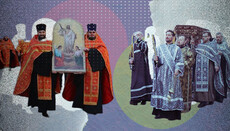
When we walk behind the Shroud on the evening of Great Friday, we are following the body of Christ. Above us, the dark cloth embroidered with the image of the dead God moves slowly on, and hundreds follow it the way mourners follow a coffin. Eyes drop instinctively to the ground, steps grow heavy, and the occasional whisper dies away. Candles flicker unevenly in our hands, hot wax dripping onto our fingers, yet hardly anyone seems to notice.
Those who join the Friday procession are not there to fulfill some higher spiritual task. In the end, the long route around the church brings them back to closed doors. And that ending feels like a silent, hopeless cul-de-sac – like the funeral of someone deeply loved, a loss too painful for the heart to make peace with.
The philosophy of grief
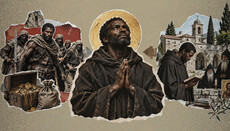
There is one striking detail in the Gospel that we rarely stop to consider. At Christ’s burial, none of those who had most loudly vowed to remain faithful to Him unto death were there. Those who had spent three years listening to His preaching and following Him along the dusty roads of Galilee had simply disappeared. And it is not hard to understand why – raw, elemental fear can paralyze even the strongest.
Instead, others step out from the shadows. The body is carried by Joseph of Arimathea, an influential member of the Sanhedrin, and by Nicodemus – the same cautious man who had once come to Jesus only at night, avoiding the eyes of others. It is these hidden disciples from the safe margins who remain near Him at the most terrible moment. Mark describes their actions dryly, almost matter-of-factly: he bought a shroud, took down the body, wrapped it, laid it in a tomb, and rolled a heavy stone against the entrance.
At that hour, none of the familiar circle of disciples stood by the tomb. There was no comforting prophecy, no clear plan for tomorrow. There was only the resolve of two men to do what had to be done when everyone else had scattered in fear.
The Church structures the Friday procession with real psychological insight. We are not asked to put on a show of strength or to pretend that we are already at peace. Quite the opposite: when the procession returns, the Shroud is lifted high above the entrance to the church, and the faithful pass beneath it with heads bowed low. In that moment, it is as though one bows before death itself and enters beneath its cold covering. From the high bell tower come the slow, measured strikes of the funeral toll. It seems as though the very sound is parting, with immense effort, from something bright and pure that is leaving us forever.
At that moment, there is no need to pretend that we already know the happy ending – though of course we do.
The procession of Great Friday is an honest passage into catastrophe. And without passing honestly through that pain, nothing within us will truly change.
The deep dawn of hope
All through Saturday, the church stands in a kind of stunned silence. Life itself seems to have paused. Yet something begins to shift, almost imperceptibly, even before the second procession of the night begins. The clergy, who throughout Great Lent have served in austere dark vestments, change into white already during the daytime Liturgy of Great Saturday. They step out into the darkness of night already clothed in light. In this way, the inner vision changes just before the miracle itself takes place.
The Paschal procession begins very differently. It has no heavy center of gravity – the Shroud has already been taken into the altar. Only the Cross and an icon are carried in front. The gaze lifts from the ground, the step grows noticeably lighter and quicker. The sparse and mournful funeral toll gives way to an unbroken, triumphant peal.
And then, suddenly, the procession stops. Once again, the crowd finds itself before the western doors of the church. By ancient custom, the doors are closed before the worshipers. For several long minutes, a strange, ringing pause hangs in the air. People simply stand there with lit candles before the shut doors, not knowing what is happening inside the church at that very moment – not knowing that it is already flooded with light, and that no trace of the former darkness remains.
The myrrh-bearing women went to the tomb in exactly this same unknowing. The Greek text of Luke’s Gospel calls it “deep dawn” – that hour when the heavy night has not yet ended, and the first light has not yet truly appeared. They carried precious spices simply to complete the burial rite. They were going to mourn, not to meet the risen God. There was no expectation of triumph.
The Paschal procession is a living out of their path – the path of people who walked through darkness with broken hearts. We enter not into an already-possessed triumph, but into a fearful unknown.
The blow of change
The priest, holding the censer, approaches the closed doors. And the very first, piercing “Christ is risen!” is heard not inside the church, radiant with light, but outside – in the cold spring night, before the locked doors. And then those doors are suddenly thrown open from within.
Only a short span of time separates the two processions. But that is not really the point. What matters is how that time is lived.
In the first case, we move blindly behind a loss that has taken hold of the whole soul. The Church does not conceal that burden from us – it allows us to feel it to the very bottom.
In the second, everything outwardly seems exactly the same: night, cold, uncertainty, shut doors before the eyes of the faithful. And yet standing before that barrier has become something entirely different.
The difference between Friday and Pascha is the difference between a wall and a door. A wall means a hopeless end. A door means that there is space beyond it – and that sooner or later it will open, and when it does, it will change our lives forever.